A few weeks ago the head of one of the agronomy firms we work with rang me to ask what he and his team should be doing about AI.
It's not the first time I've been asked. AI is coming up at more and more winter meetings, and in October Farmers Weekly ran a piece on 'Giles', an AI agent built by Clive Bailye, the farmer behind The Farmers Forum, which helped him get into SFI26 before the funding pot closed.
So I've had a go at setting out how I think AI will change farm software, and what that means for agronomists and farmers this winter. I go through my thinking in detail below, but in short, two things stand out. First, I think most of us will end up with a single AI 'assistant' that works across all our systems, rather than a chatbot inside each one. Second, that makes good farm software more important, not less - but only the kind that fits this way of working.
I'll go through three things:
- The levels of AI adoption
- What happens to farm software
- What it means for agronomists
Fair warning, it's a long one. Grab a cup of tea, skip to 'What I'd do this winter' near the end, or ask your AI to summarise it for you 😄 There's also a shorter version on LinkedIn.
Why I've got a view
I spend my working life between software developers and agronomists, so I've had to think about this a lot. My Nuffield Scholarship looked in part at how advisors around the world were starting to use AI. And in the last year our team of six developers has rebuilt our whole platform and launched four products. By several measures we're now about ten times more productive than we were at the start of 2025.
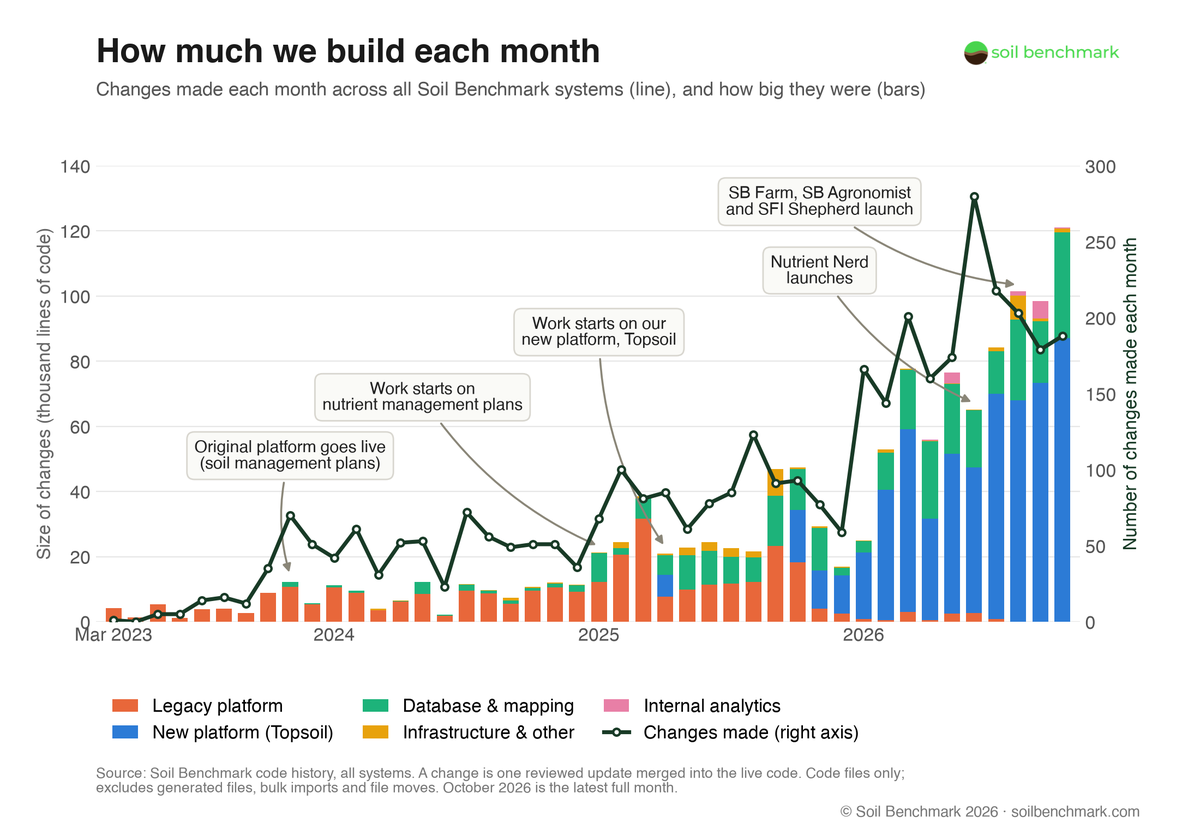
That's only possible because we've spent months reshaping how we work around AI, so we can move this quickly and still build what customers actually ask for, in an app that stays fast and reliable as it grows.
I use AI as an integral part of how I work too. I've connected mine to my email, calendar, files, our marketing database and what our developers are working on, so it does whole jobs for me. After every customer call, for example, I run a routine I've built that goes through the recording, pulls out each piece of feedback and checks it against what's already on our development team's to-do list, so nothing gets missed. It drafts the notes for me to check, then files them in our team chat, the development list and our marketing database.
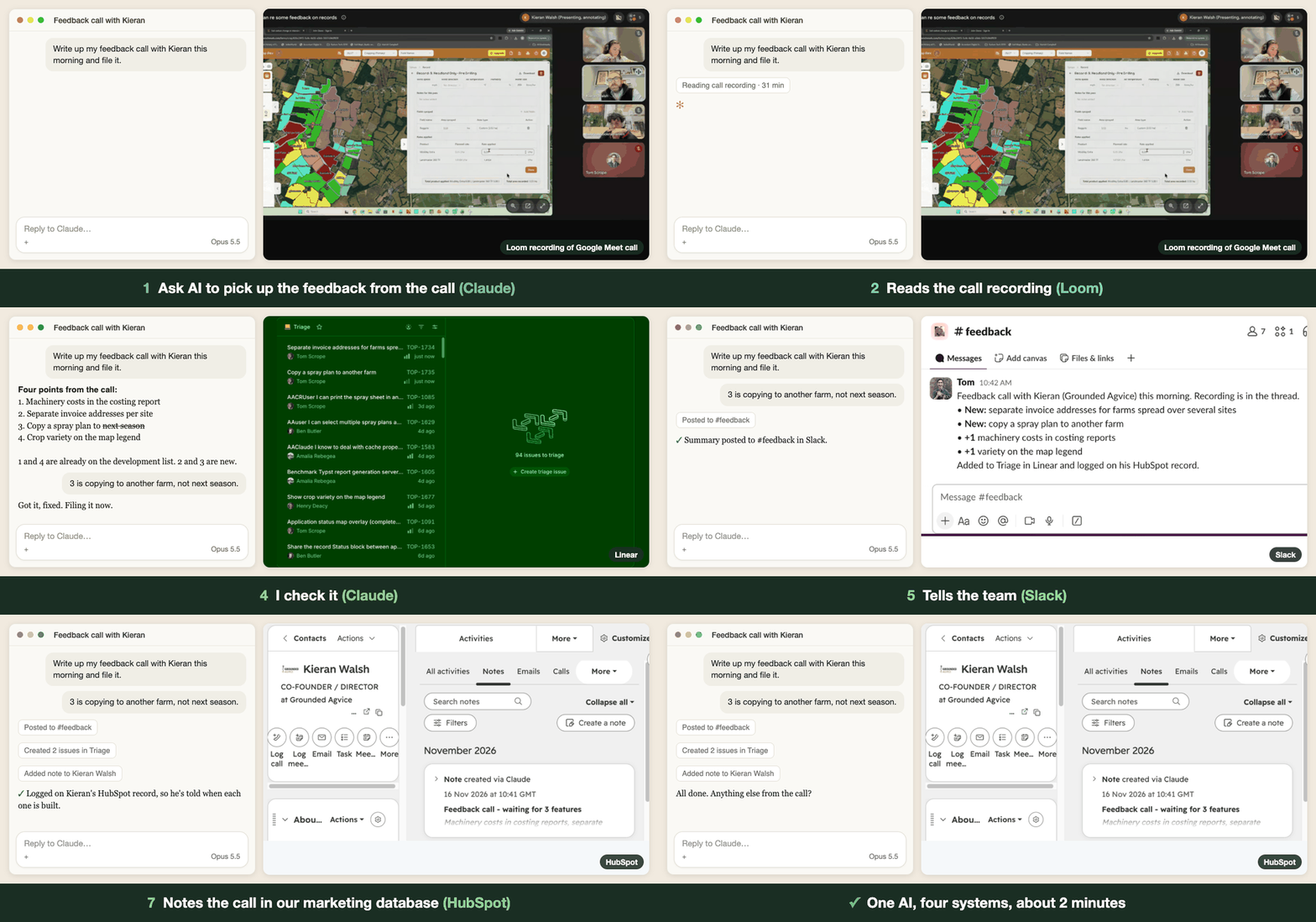
That's the way of working I think most agronomists will end up with, just connected to their farm software, email and WhatsApp.
The levels of AI adoption
From what I've seen, there are four levels. Where you stop is up to you.
Level 1: ignore it. A fair choice, and you'll be fine for a while, but others will use it. For an agronomist the cost is mostly personal. More evenings on admin, and I've never met one who got into it for the paperwork. For a farm business it's more serious. Records fall behind, or a rule gets missed at an inspection. There's a legal angle creeping in too. Professionals could in time be negligent for not using AI where a competent peer would.
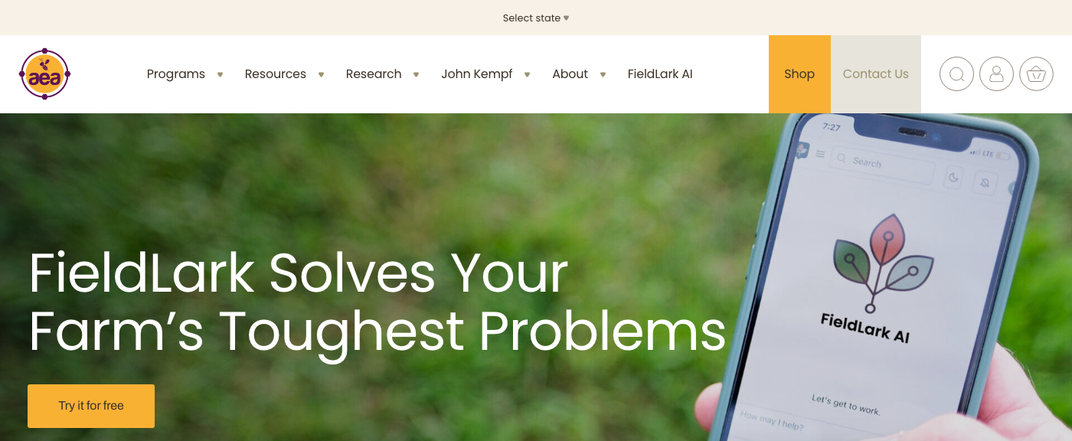
Level 2: a better Google. Ask it an agronomic question and you get a decent answer, like a well-read (and slightly nerdy) colleague you can ring at any hour. John Kempf's FieldLark is a good example. The catch is that it sounds confident even when it's wrong.
Level 3: hand it one job at a time. This is where most of the time savings are right now, on jobs like writing up crop walking notes, drafting client emails and pulling numbers out of PDFs. One agronomist put it to me well. AI hasn't changed what matters in his job, it's just made the simple but time-consuming jobs much quicker.
Level 4: build it into how you work. You connect it to your email, files and software and hand it whole jobs, not just questions. This is my strong recommendation. I think it's where most people will end up anyway, so it pays to get in early. It also raises a bigger question. What happens to farm software?
So what happens to farm software?
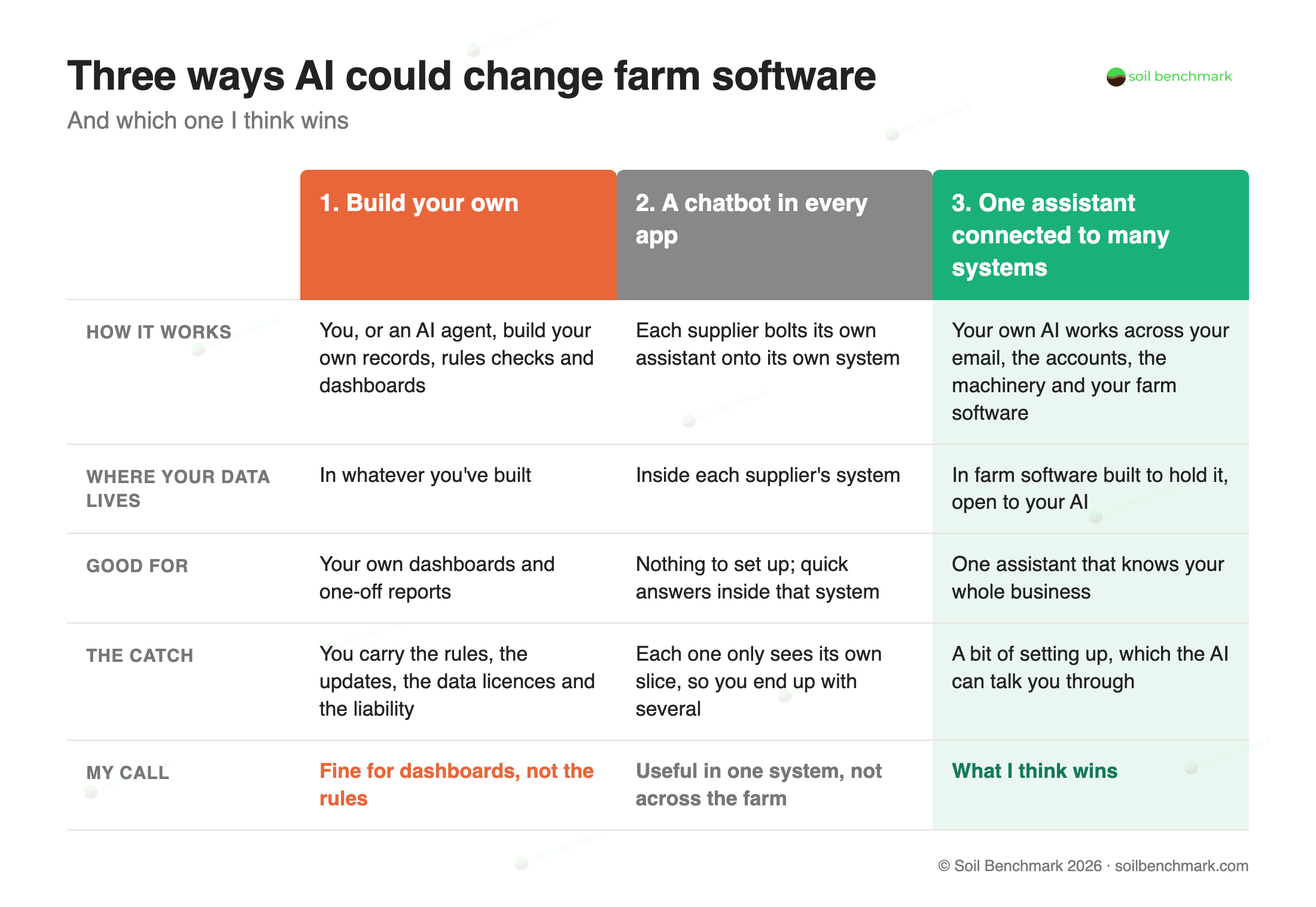
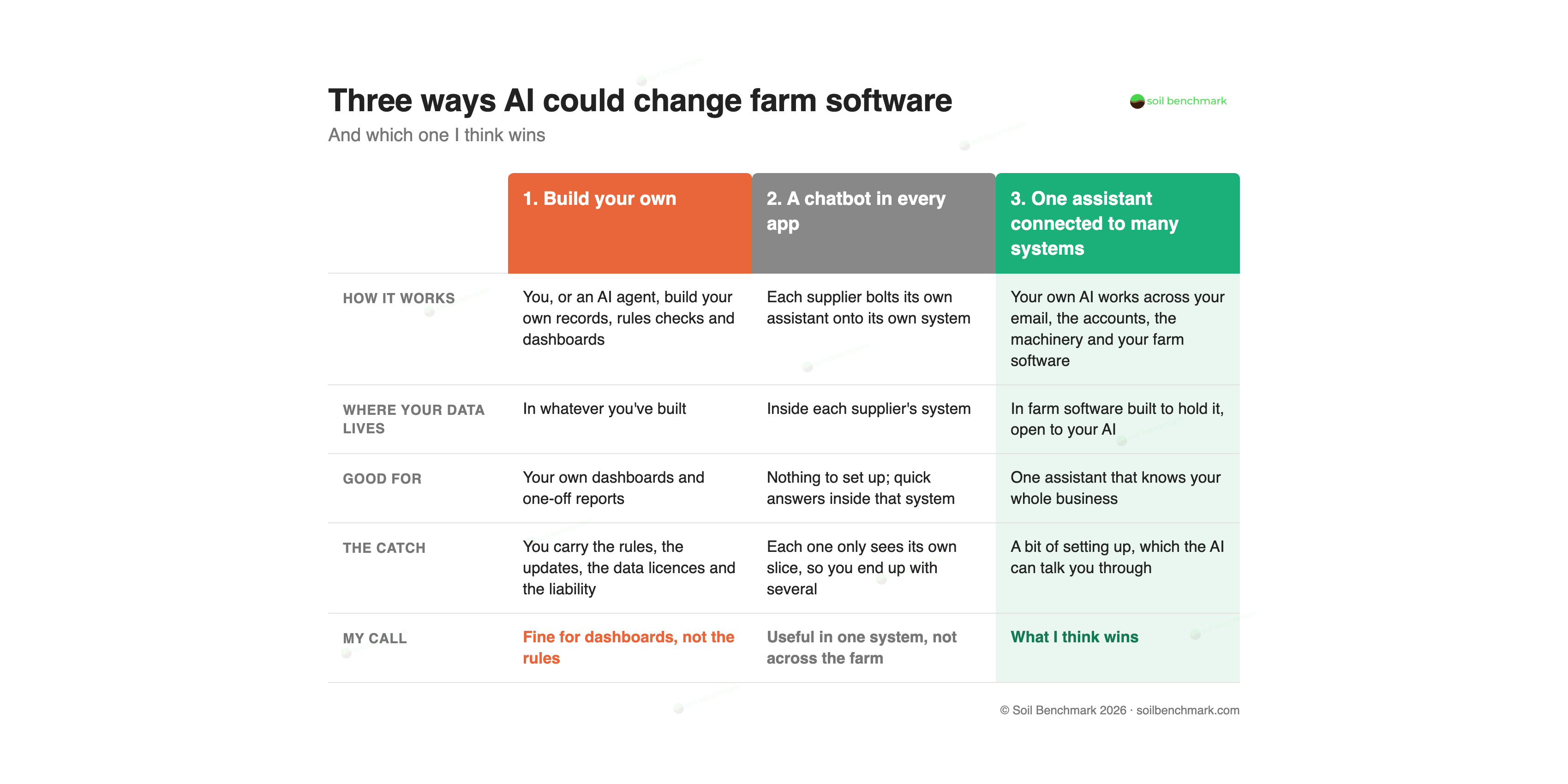
1. Build your own. AI can build you a decent dashboard or report quickly, and a few of the AICC's younger agronomists are trying it out. If you're paying thousands a year for your current system, I can see why, and the fact that this option exists will keep software prices honest.
But a dashboard isn't farm software. Just copying how an existing system looks takes months, even with plenty of AI. Copying the complex checks underneath, and keeping them up to date as the rules change, isn't something you can just hand to AI. The same goes for an AI agent like Clive's 'Giles', with its own "farm memory" of yield maps, soil tests and SFI agreements. Once it needs somewhere structured to keep the farm's data, and you need to check what goes in, it's building its own farm management software from scratch, and taking on everything that comes with it:
- The rules. RB209 isn't just the book. The printed guidance has gaps that need judgement. We use AHDB's RB209 service, which goes much further than the printed tables; one of our developers, Sabrina, sat her FACTS exams to make sure we'd interpreted it properly (she's actually been nominated for the Brian Chambers award for the top FACTS candidate!); and it's been checked against hundreds of agronomists' own numbers.
- Keeping up. Product approvals change weekly, NVZ maps and SFI actions change, and England, Wales and Scotland all differ. I think AI makes the generic parts of farm software cheap, and leaves the local rules, and keeping up with them, as the part that holds its value. That's also why I think big global platforms will find it harder, not easier, to add value in the UK.
- The data. We pay for licences for Ordnance Survey mapping and watercourses, BGS soils, AHDB's RB209 and Fera's product approvals. These licensed datasets alone run to many thousands of pounds a year.
You're welcome to try, and you'll learn a lot about AI doing it. But we're six developers using AI all day, with hundreds of users telling us what's wrong, and it took us months to find a way of working that keeps the app fast and reliable as it grows. Agronomists are the most time-poor people I know. Do you want to become a part-time software developer as well? For your own dashboards and reports, go for it. For the rules-heavy core, my honest guess is that most people who try will end up back on a proper system, whoever it's from.
2. Every app gets its own chatbot. Some software suppliers will add an assistant to their own system, and some will be good. John Deere launched a free one inside OpsCenter in September (US only so far) that answers questions about your machine and field data. That's useful.
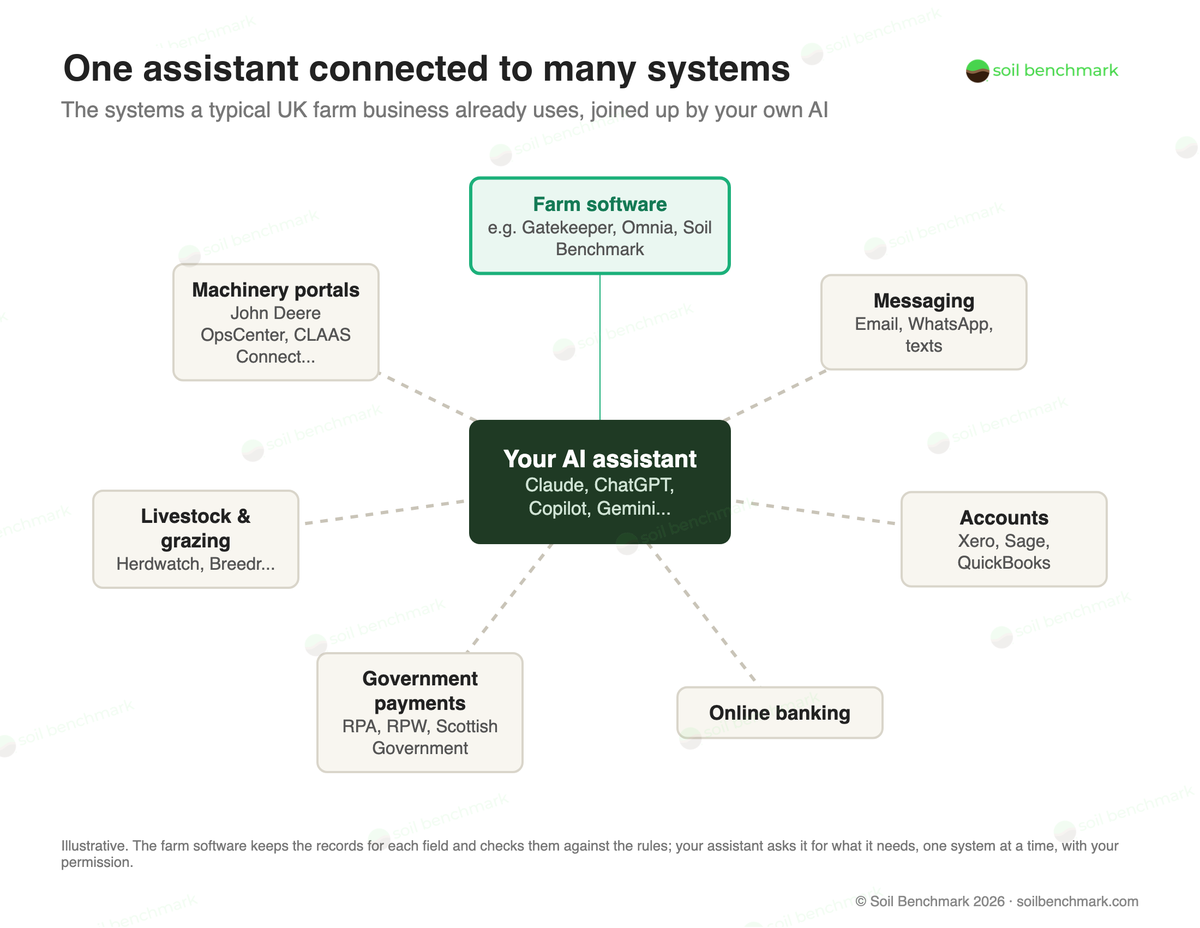
But no farm relies on a single piece of software. There's email and WhatsApp, the accounts, the bank, and often a livestock app and a machinery portal. Several chatbots that each see one of those will always be less useful than one assistant that sees them all. Their main advantage is that there's nothing to set up, which gives them a few years while people move up the levels. If I were advising other software suppliers, I'd say save yourselves the time and open up to people's own AI instead.
3. One assistant connected to many systems (the way I think will win). You have your own AI assistant - Claude, ChatGPT, Copilot, Gemini, whichever you prefer - and it works across your email, the accounts, the machinery and your farm software. Before long, I think paying for one will feel as normal as paying your phone or internet bill.
Olly Pemberton, who manages the farm at Waddesdon for Velcourt, has an add-on in his web browser that lets his AI log into his farm software for him, the same way he would. It pulls out the data, turns it into whatever reports he wants, and joins them up with Land App, his email and WhatsApp. He hasn't built any software, and needed nothing special from his supplier.
Why I think this approach will win out:
- It sees the whole picture. Did the contractor apply what the agronomist recommended, at the right rate? Was the product invoiced at the agreed price, and has it been paid? The rec is in your farm software, the application in the machinery portal, the contractor's messages on WhatsApp and the invoice in the accounts. One assistant can pull that together. Four chatbots can't.
- No typing needed. These assistants now understand speech really well, so you can just talk to yours in the truck after crop walking and it drafts the notes, the rec and the records for you to check.
- It doesn't have to be scary. You choose what it can see, one system at a time; you can let it read without letting it change anything; and nothing becomes the record until you've checked it. I still read every email my AI drafts, and I don't let it delete anything itself.
So will farm software still be here in ten years?
You'd expect me to say yes, but some of the talk about AI killing off software is right. Your AI can now build a decent website in an afternoon, and plenty of simple apps just as easily. So I think farm software will move towards fewer, more comprehensive systems that do the hard parts, not lots of small tools for jobs your AI can now just do for you.
It's a live question too. A couple of weeks ago TELUS, which owns Gatekeeper, announced it's looking to sell its agriculture business. Plenty of people are wondering what comes next, and whether they need farm software at all with AI. I think they will, for three reasons.
Your AI can't hold the whole farm in its head. Every AI can only keep so much in mind at once, and once that fills up it gets muddled and starts missing things. To check whether a farm has broken any NVZ rules this year, it needs every field, every application and the map, and then five separate checks, including the spreading map, without missing one. A spray plan is more like twenty. And many of these rules depend on where things sit on the map, such as how close a field is to a watercourse. AI chatbots are built for words, not maps, so that needs map-based farm software that holds the map data.
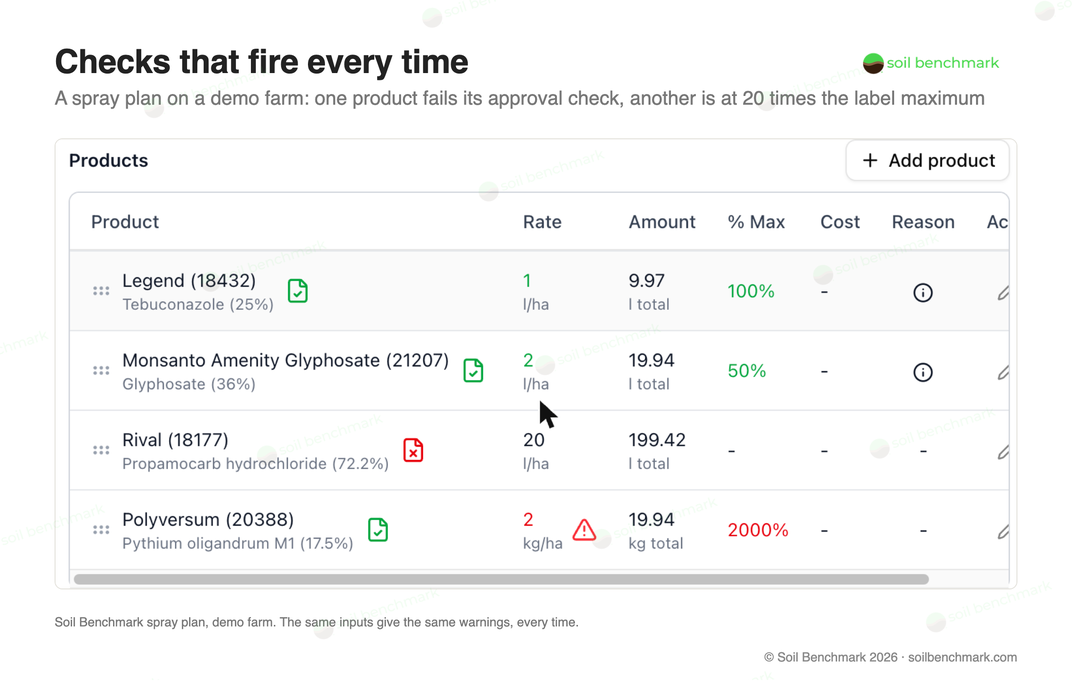
The rules have one right answer. AI works on probability. Ask it the same question twice and you can get two different answers. Compliance rules don't work like that, and "the AI got it wrong this time" won't be much of a defence at an EA inspection. You need something rules-based that gives the right answer every time, and hands that answer to your AI.
You need to check it before it counts. Whether you're bringing data across from another system, uploading soil analysis or splitting a field, you want to see it on a map and confirm it before it becomes the record. Laying out a whole farm so you can check it quickly is a key part of what we do.
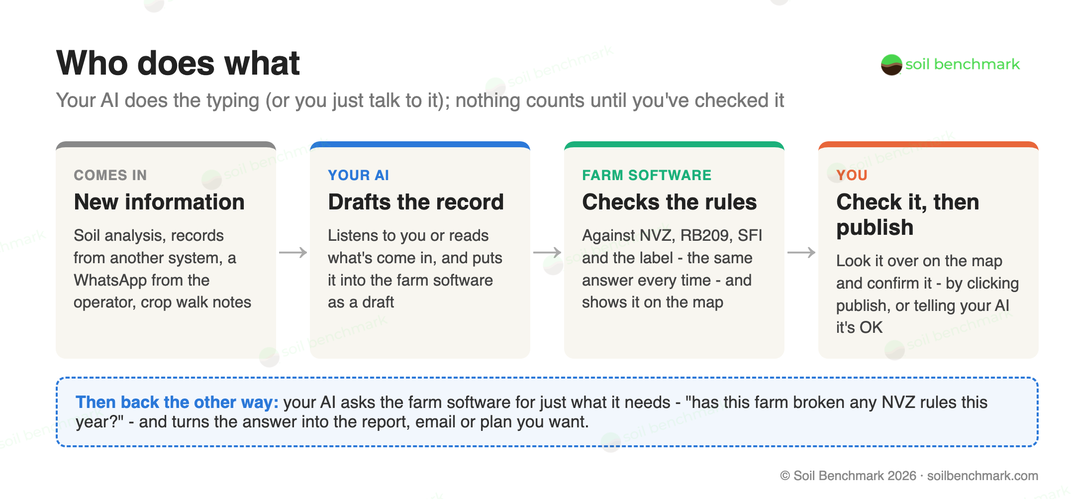
So I think farm software will become the layer underneath. It's where your data is checked against the rules and stored safely, and where your AI goes for reliable answers. Olly shows you can do this today with your AI clicking through the screens, but that's a workaround. Screens are built for people, asking one thing at a time, which just slows an AI down. A direct connection built for AI (the techies call it 'MCP') means the software can be quick for both humans and AI.
So the question to ask your software supplier this winter is: "Will you let my own AI access my data, safely, through an MCP connection?"
What it means for an agronomist's job
Your clients will be using it too. More farmers will run your rec past their own AI before they act on it. Andrew Robinson, farms director at Heathcote Farms in Bedfordshire, let AI plan the fungicides on half a hectare of his wheat this year. On the Farmers Weekly Farm Insight podcast, he said the most useful thing was that it disagreed with him and made him question his own programme (and perhaps his agronomist's too!). Being able to explain why your advice is right for that field will add to your credibility - or you might both learn something new.
Does AI beat the agronomist? Not yet on its own. Agrii's trials, described on the same podcast, found that leaning about 90% on the technology lost around a tonne a hectare against the farm standard, while a roughly half-and-half split came out about £140 a hectare better on gross margin. Olly is testing it this season, with his recs on one field and exactly what AI says on the one next to it. So far, AI with a good agronomist beats either on its own.
Whose data has it learned from? Olly made a point I hadn't thought of. Much of the published agronomy an AI learns from comes from the companies selling inputs, while independent agronomists, researchers and farmer groups often keep their trial data private. So an AI that only knows the internet may keep nudging farmers towards higher-input, higher-cost programmes. (Andrew's AI programme cost more than his own.) The flip side is that knowledge the chatbots can't see becomes more valuable. For independents and researchers, the question is whether to keep that data private, pool it, or train AI of their own.
What clients pay for will shift. If AI makes write-ups quick and cheap, the value moves further towards walking the crop and the judgement calls only you can make. If part of your fee is really for paperwork, it's worth thinking now about how you'd charge if it took a tenth of the time.
Your name is still on the rec. If a rec was drafted with AI, or came out of a tool someone in your team built, who checked it? Do you know what's going out under your company's name, and would your professional indemnity cover it?
How do juniors learn? A lot of judgement is built doing the grunt work. If AI does that, firms will need a plan for how trainees still learn to spot when something's wrong - though a junior with an AI that explains its working could learn faster than one copying last year's recs.
What I'd do this winter
- Pick one weekly admin job - turning crop walking notes into recommendations and a client email is a good one - and try AI on it.
- Get a business AI subscription. Free and personal AI accounts can use your conversations to train their models unless you turn that off. A business subscription is about £15 per person per month, and worth it before you paste in client data or your price book.
- Build up access one job at a time. Start with your farm software and email, and add more as you need it. That's how mine grew.
- Give everyone their own login, so you can see who changed what. If a rec is ever questioned, it's the first thing your insurer will ask.
- Ask your software suppliers: "Will you let my own AI access my data, safely, through an MCP connection?"
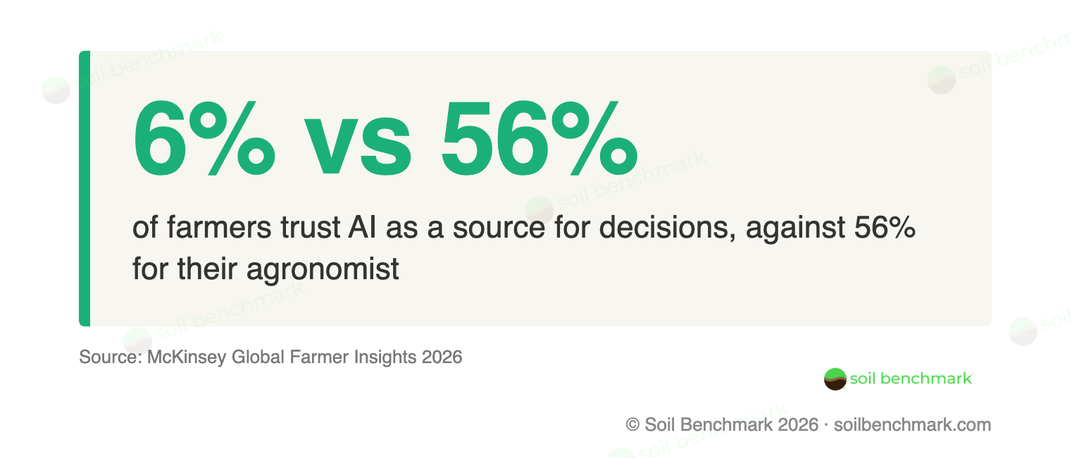
The biggest finding from my Nuffield still stands. Farmers change because of people they trust. McKinsey found only 6% of farmers trust AI as a source for decisions, against 56% for agronomists. So AI isn't anything to be gloomy about. Used well, it takes the admin and leaves the judgement with the people farmers trust. Ignore it, and you'll keep spending more of your week on admin than you need to.
On our side, Soil Benchmark will be open to your own AI assistant before Christmas. I'll be talking about this at the AICC conference in January. The AICC is also surveying its members on how they're using AI, with results due in the new year, which will be well worth a read. And if your team, discussion group or winter meeting would find a session useful, I'd be happy to come and talk. We're still learning too.
Hope you find this useful, and do let me know if you disagree - you can email me at tom@soilbenchmark.com.