A few people have asked me what DEFRA could do to make SFI27 reach more farms than SFI26 managed. I had a dig through the published data and thought it worth sharing more widely. There is a shorter version on LinkedIn here if you would rather skim it.
For context, we reckon there could be 35,500 applications chasing c. £310m if SFI27 opens next spring. At the £20,700 average agreement we saw in Window 2, there would only be enough money for about 15,000 (42%) of them.
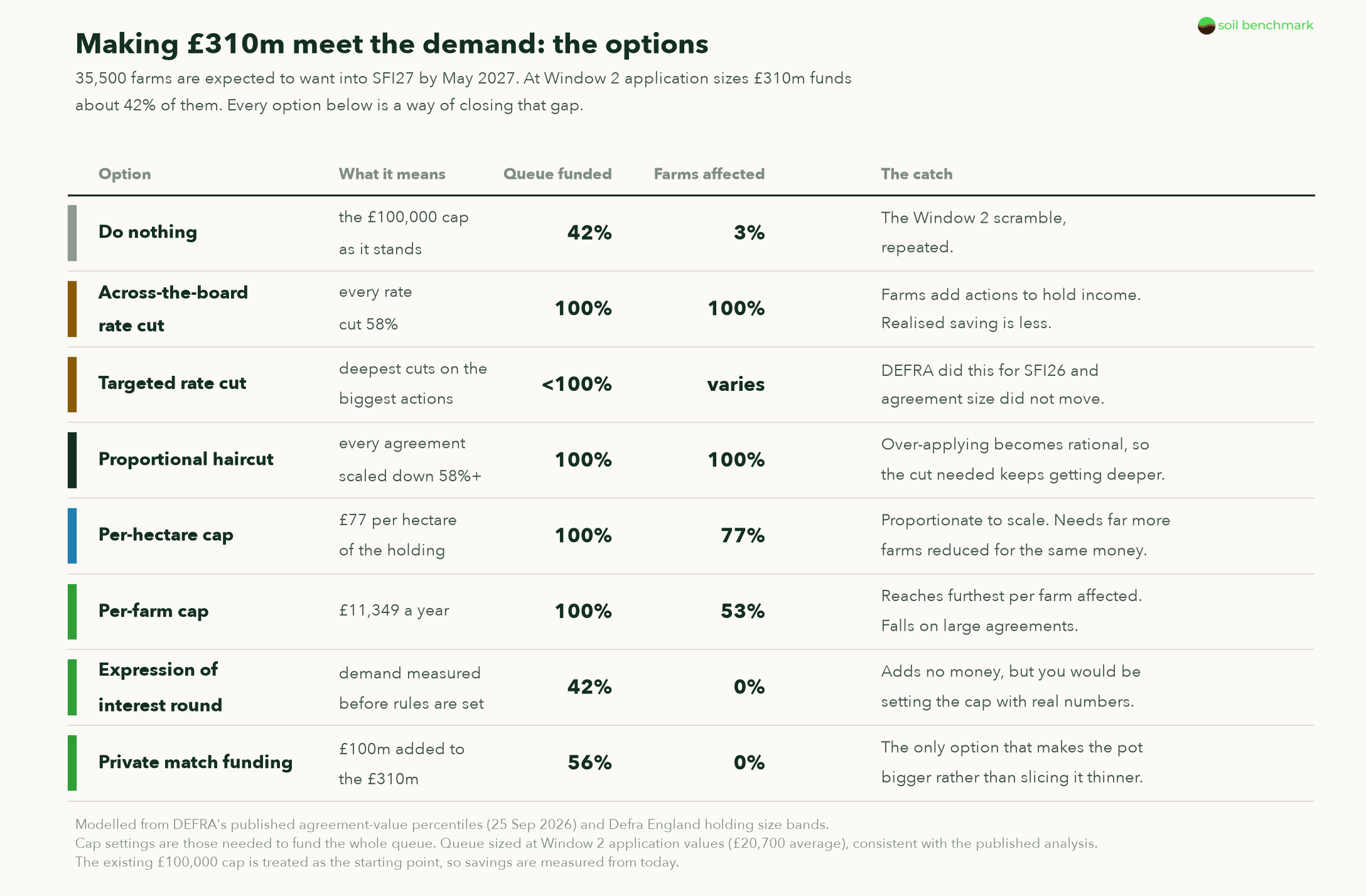
There are only two ways to close that gap. Make farms want less, or limit what each farm can have. I've run the numbers on a few of the options I've seen floated - let me know if I've missed one you want me to check out.
Rate cuts (counterintuitively) don't free up money overall
DEFRA cut its three biggest actions by spend for SFI26: SAM3 -41%, AHL2 -24%, NUM3 -10%. With the planning actions cut too, if choices had stayed the same the average agreement should have fallen to about £15k. Instead it rose (!) a touch, to £20,700.
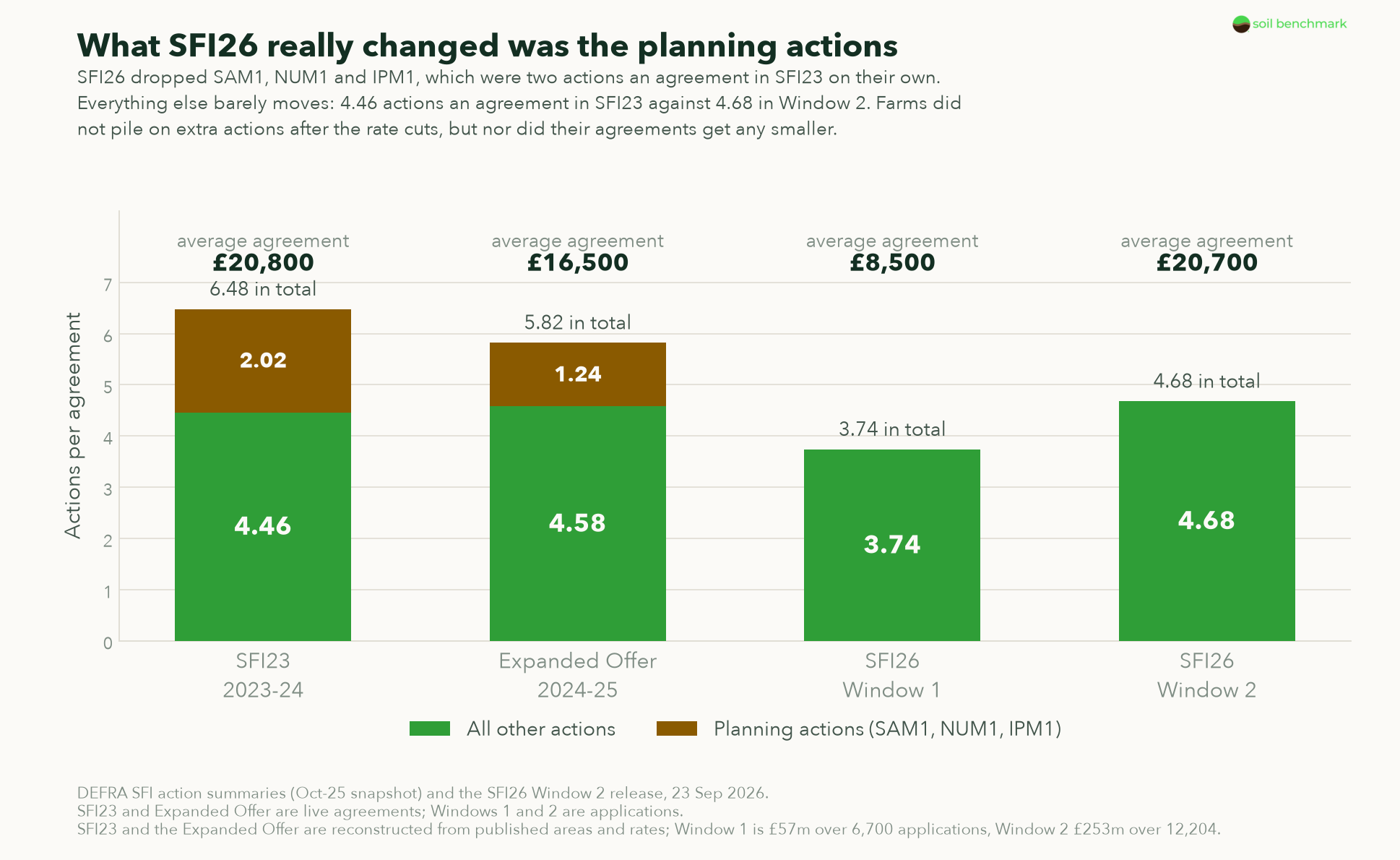
The budget therefore went no further: £253m covered 12,200 farms, not the 16,900 it would have if the rate cuts had led to smaller agreements.
These were largely farms rolling over existing agreements. Of the 12,204 Window 2 applications, 90% were already in SFI. Only 1,168 were new. Farm size cannot explain it.
They also didn't do it by selecting more actions.
They did it by putting more land into agreements (about 60% of the 13% cut their old mix would have taken) and switching to more lucrative actions (the other 40%). AHL1 pollen and nectar now pays £739/ha, up 20%, and AHL4 buffer strips £515/ha, up 14%. SAM3 herbal leys, whose rate fell 41% to £224/ha, fell from 39% of agreements to 28%.
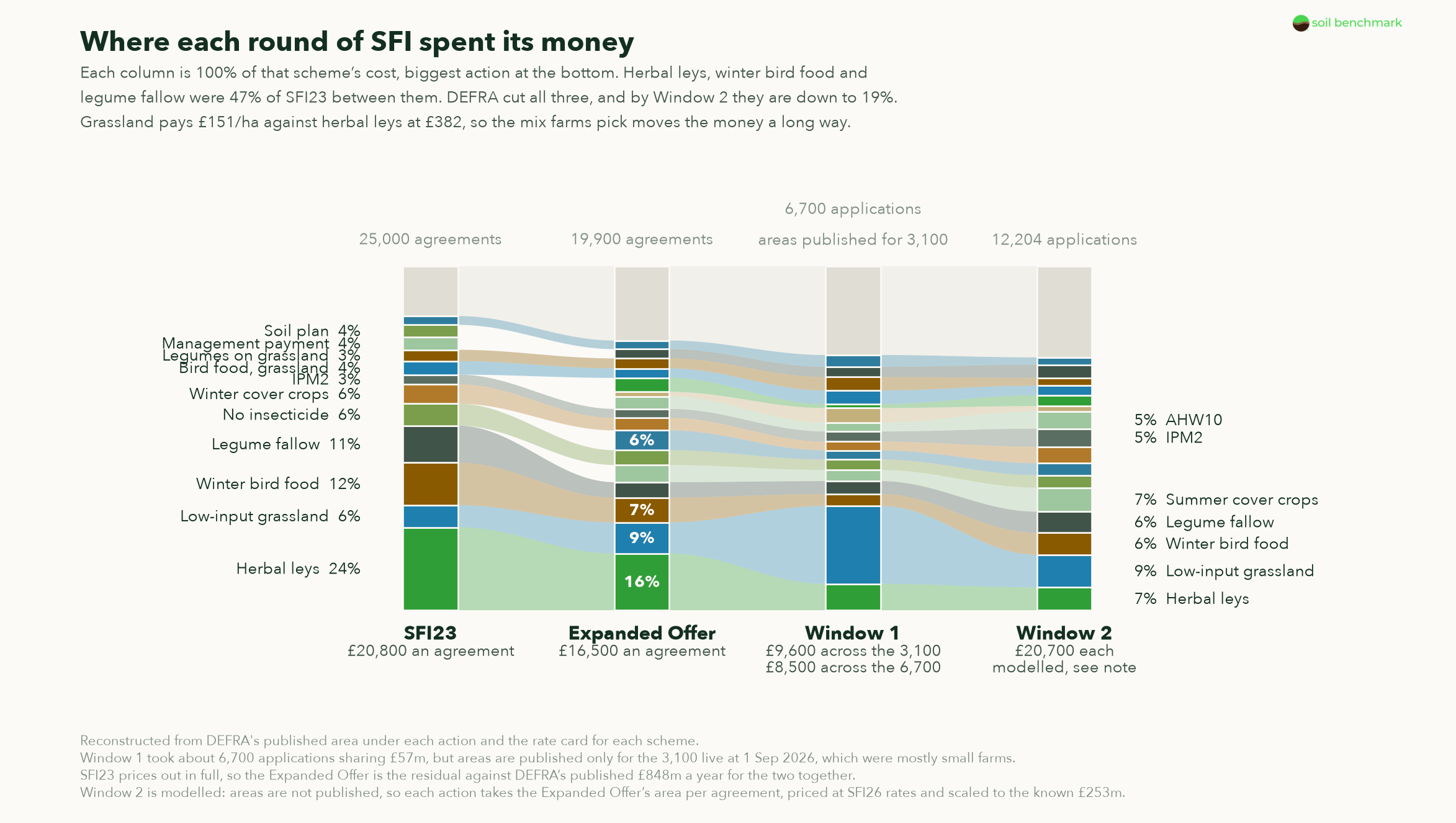
Herbal leys alone went from 24% of the spend to about 7%.
'Bundling' popular actions with more onerous ones runs into the same thing, as does cutting every rate. A farm that needs the stable income will put up with the bundle, or simply apply for more actions across more land, to get the agreement value back up. It may provide more 'value for money' for DEFRA, but it won't spread SFI's reach.
And DEFRA using its pricing power against farms who need a secure income, pushing them into the red, won't help taxpayers in the long run.
What the two caps actually did
SFI has two caps built in already. The 25% limited-area rule arrived in March 2024, midway through SFI23, when it became clear some whole farms were being taken out of food production.
Both do something. The 25% rule stopped whole farms going into wildflower mixes, with area per agreement falling 39% against 17% for comparable uncapped actions, worth about £14m a year or 575 farms. The £100k cap caught 250-350 big applications in Window 2 and cuts the queue by roughly 1,250. Between them that is 1,800 farms against the 20,500 who miss out, so neither is set low enough to matter.
Lower caps would do much more, because the money is so concentrated. The top tenth of agreements hold 43% of the budget.

A £50k cap means 2,300 more farms getting in - and it limits only 10% of larger applications, since 90% are under £50k anyway.
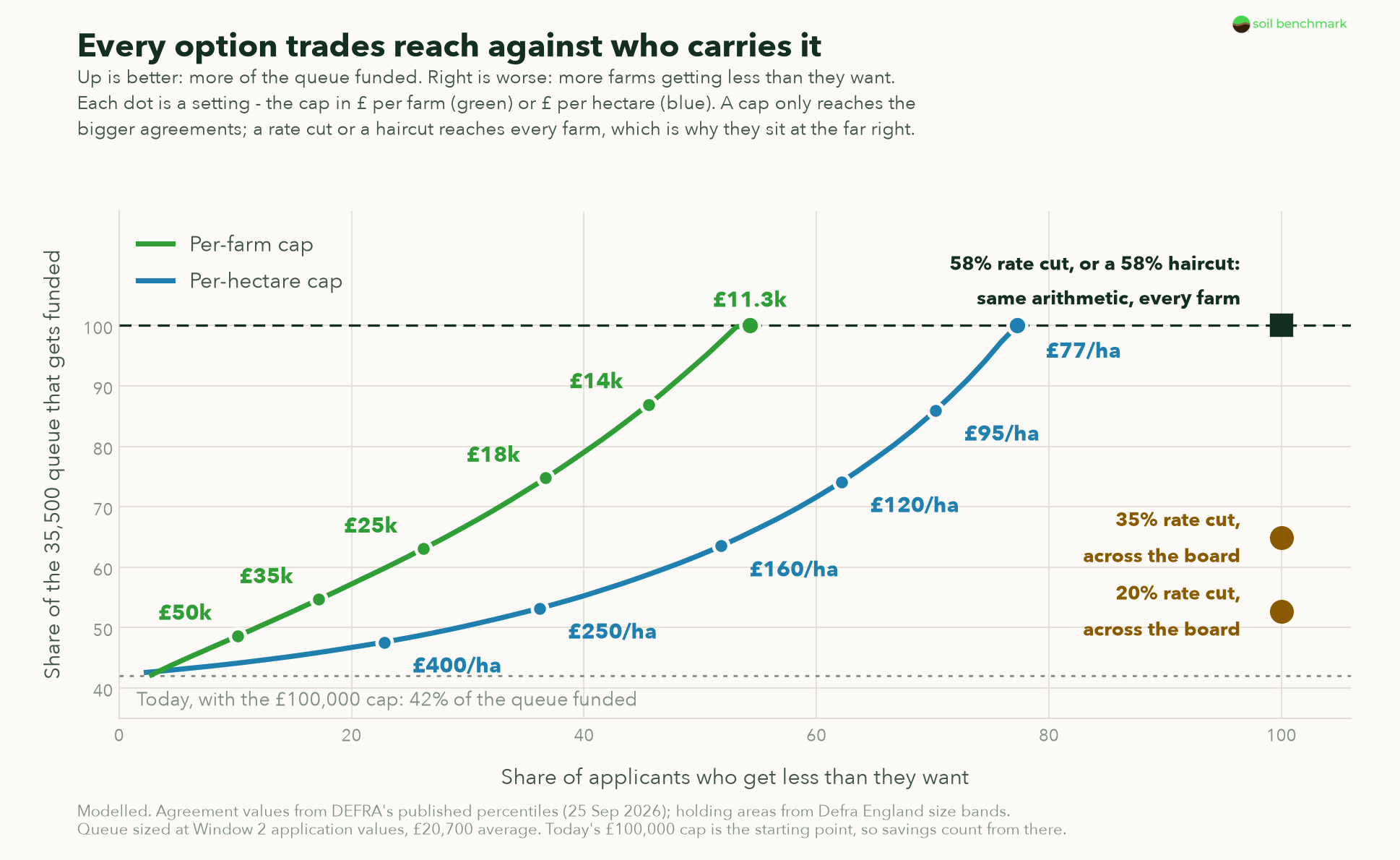
A £25k cap takes the average to £13,900 and gets 7,400 in, limiting 26% of larger applications. Clearing the queue outright would need an £11k cap, which would destroy the value of SFI to the farms that did get in. Something below £100k, plus one of the options further down, is the realistic range.
Per farm or per hectare?
There is a good argument for a per hectare cap rather than caps on agreement value, since SFI is supposed to be buying public goods and the ability to deliver those has little to do with the size of the farm business (in fact you could argue larger farms can coordinate actions across a landscape more easily). That's probably why most of the farming organisations seem to be leaning that way.
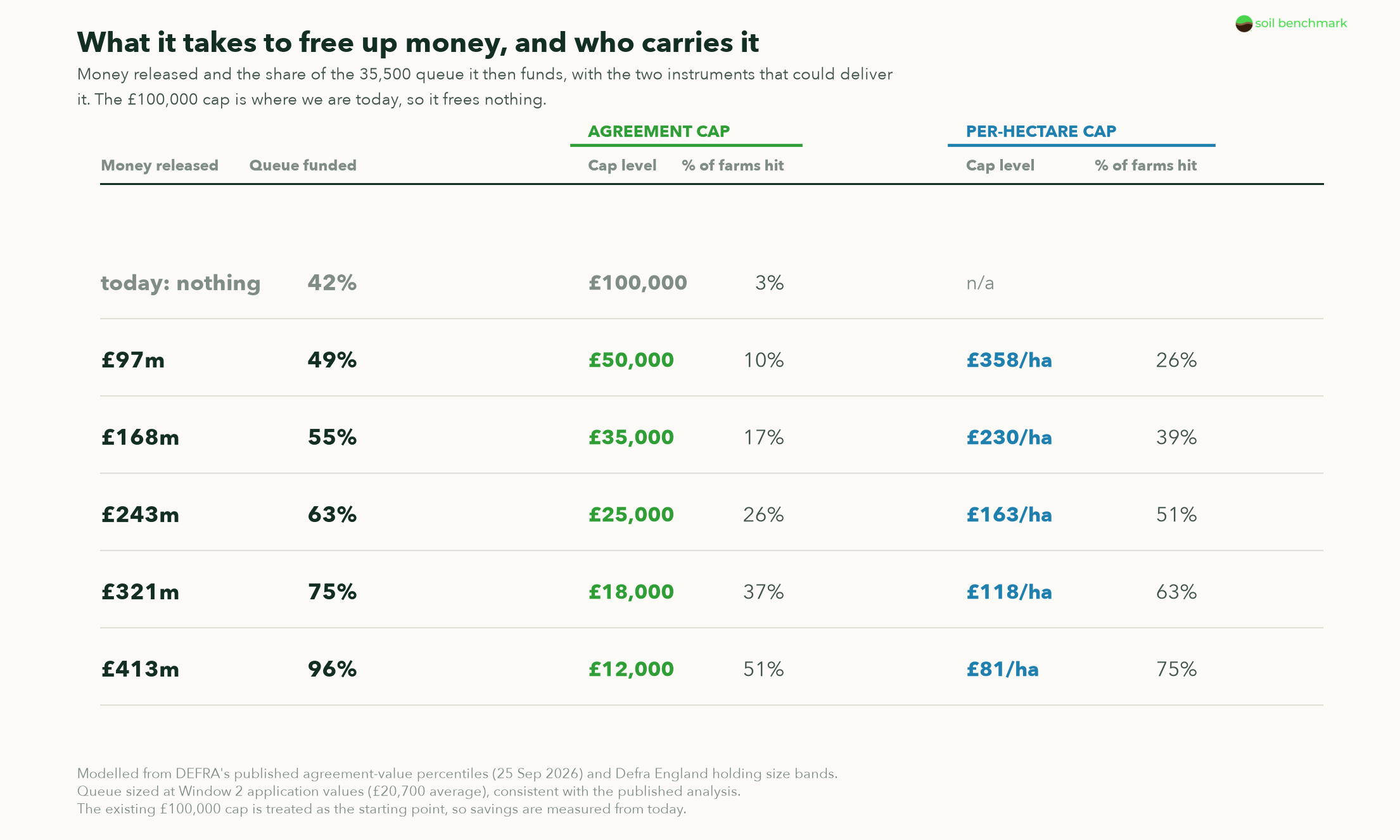
Which leaves a political question rather than an analytical one. Is it better to affect a lot of farms by a little, or a few farms by a lot?
Haircuts: cut the rate, or cut the volume
A few people have suggested a 'haircut': publish the action rates as advisory only, accept all applications, then scale everyone back by the % required to fit them all.

That scaling back could be done by cutting the rates on all actions by that %, which is contentious as it would make some individual actions unprofitable. More likely is saying you can have a % of the funding you requested, and the farm chooses which actions it cuts.
If our estimates are correct that there might be 35,500 applicants for SFI27, at the Window 2 average agreement size of £20,700, that means £735m of demand against £310m available. Every farm would get only 42% of what they asked for. It could also end up worse than that, as the incentive would be to max out your original application expecting it to be cut back to what you wanted. Any farms who didn't 'game' the system like this would lose out even more heavily.
Could you target it by place?
The other way to spread a fixed budget is spatially: cut rates outside the SDAs (Severely Disadvantaged Areas, basically the uplands), or offer some actions only inside them, so more of a fixed budget reaches the farms in the hills.
We know this is technically possible for the RPA to administer. SFI23 ran the same low-input grassland action under two codes: LIG1 outside the SDAs, LIG2 inside them below the moorland line. Presumably the RPA still has which parcels are in SDA flagged on its system.
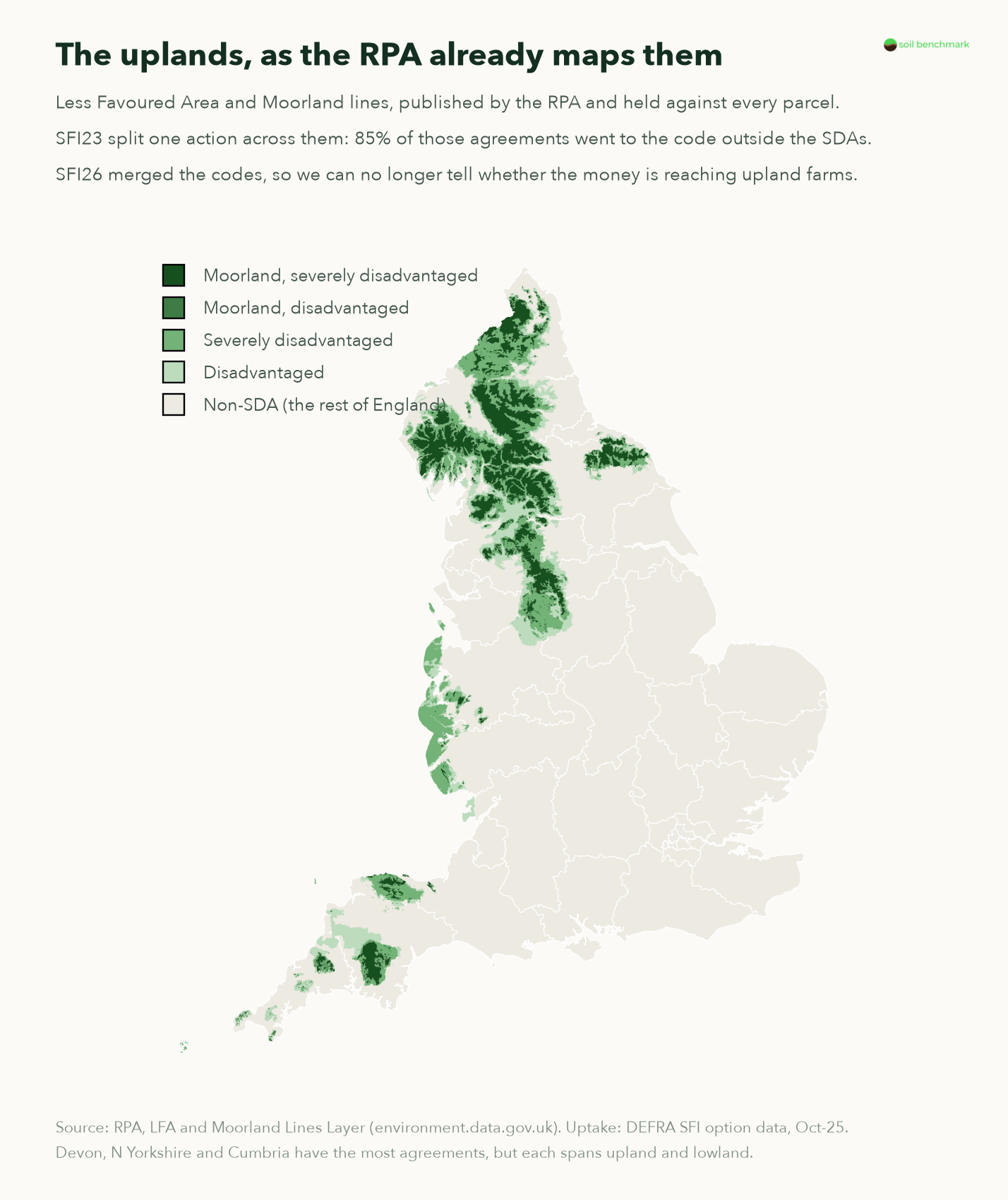
By October 2025 LIG1, outside the SDAs, had 9,800 agreements over 174,000ha. LIG2, the SDA version, had 1,700 over 47,400ha. So 85% of the agreements and 79% of the area went to lowland land, on an action designed for extensive low-input grassland.
Given the uplands are about 30% of England's 3.5m hectares of permanent grassland, on this basis they are under-represented, as the anecdotal evidence has suggested. But to know if SFI is mainly funding 'pony paddocks along the M4' we need DEFRA to publish the SFI data broken down spatially. I'm going to see what I can do, but perhaps the EFRA committee will also help - they are running a survey on SFI26 experiences for another 10 days (it closes on Friday 16 October). If you were applying in Window 2, do tell them about how it worked for you.
Scoring applications against each other
The alternative to rationing is to rank applications on what they deliver per pound and fund down the list until the money runs out. DEFRA already does this for Higher Tier and Landscape Recovery, and it would answer the real complaint about SFI26, that eligible farms missed out to whoever had an agent watching the clock.
The problem I imagine would be RPA capacity to process SFI claims at scale (SFI worth £908m in 2025 vs £272m for CS HT).
Letting farms bid for the money
The other way round is to stop setting rates and let farms bid what they would accept. DEFRA has trialled it, 129 farms across six reverse auctions in its Tests and Trials. The feedback was mixed - worked ok for well-understood actions like hedge planting, but less suited to the range of more complex SFI actions, and also no data on whether it actually reduced costs vs published rates.
Everyone gets something, or some get nothing
The real split running through all nine is whether everyone gets a bit less, or some farms get everything and the rest get nothing. First come, first served was the purest version of the latter, and scoring or a ballot land in the same place, while caps, haircuts and per hectare limits do the opposite. Given SFI is meant to be the universal layer of ELMs, and there are also likely to be benefits of keeping as many farms as possible still engaging with the schemes rather than just giving up on them, I suspect they will try and do the former.
Or just find a bigger pot
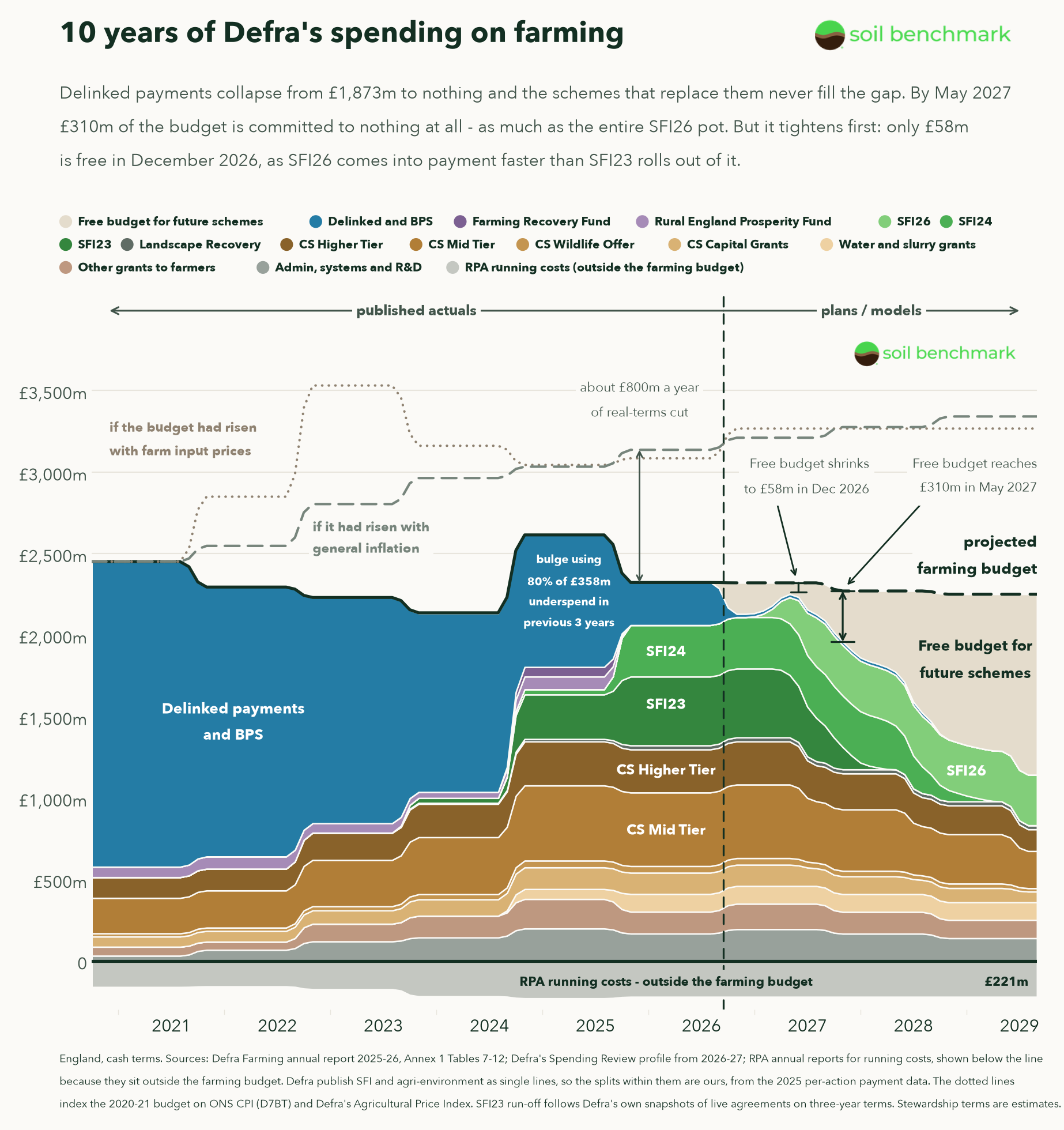
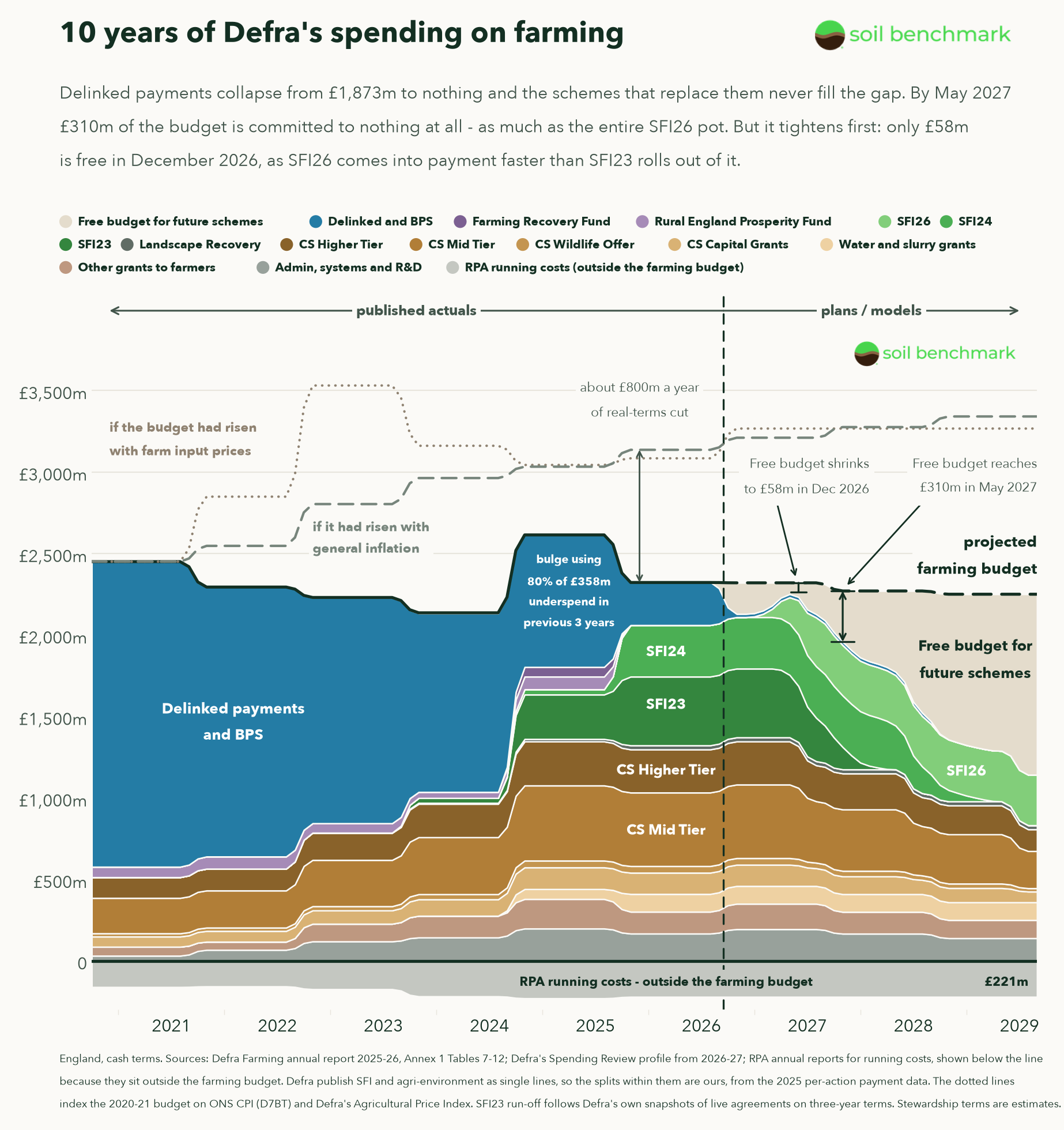
Everything above is a choice about which farms to turn away, when they all want to deliver public goods. Clearing the queue outright next spring would need about £425m on top of the £310m we estimate will be free, which is about 18 hours of NHS spending. Three ideas:
- DEFRA makes the case for the money more effectively, which needs evidence the schemes work. My co-founder Ben recently published some analysis showing how the SOM samples SFI23/24 paid for could be used to prove SFI's impact.
- Private finance finally arrives - they are probably more interested in co-funding Landscape Recovery than SFI in any case.
- It comes from inside DEFRA's own budget. £425m is about 5% of the department's 2025/26 budget, and it spends three times as much running itself.
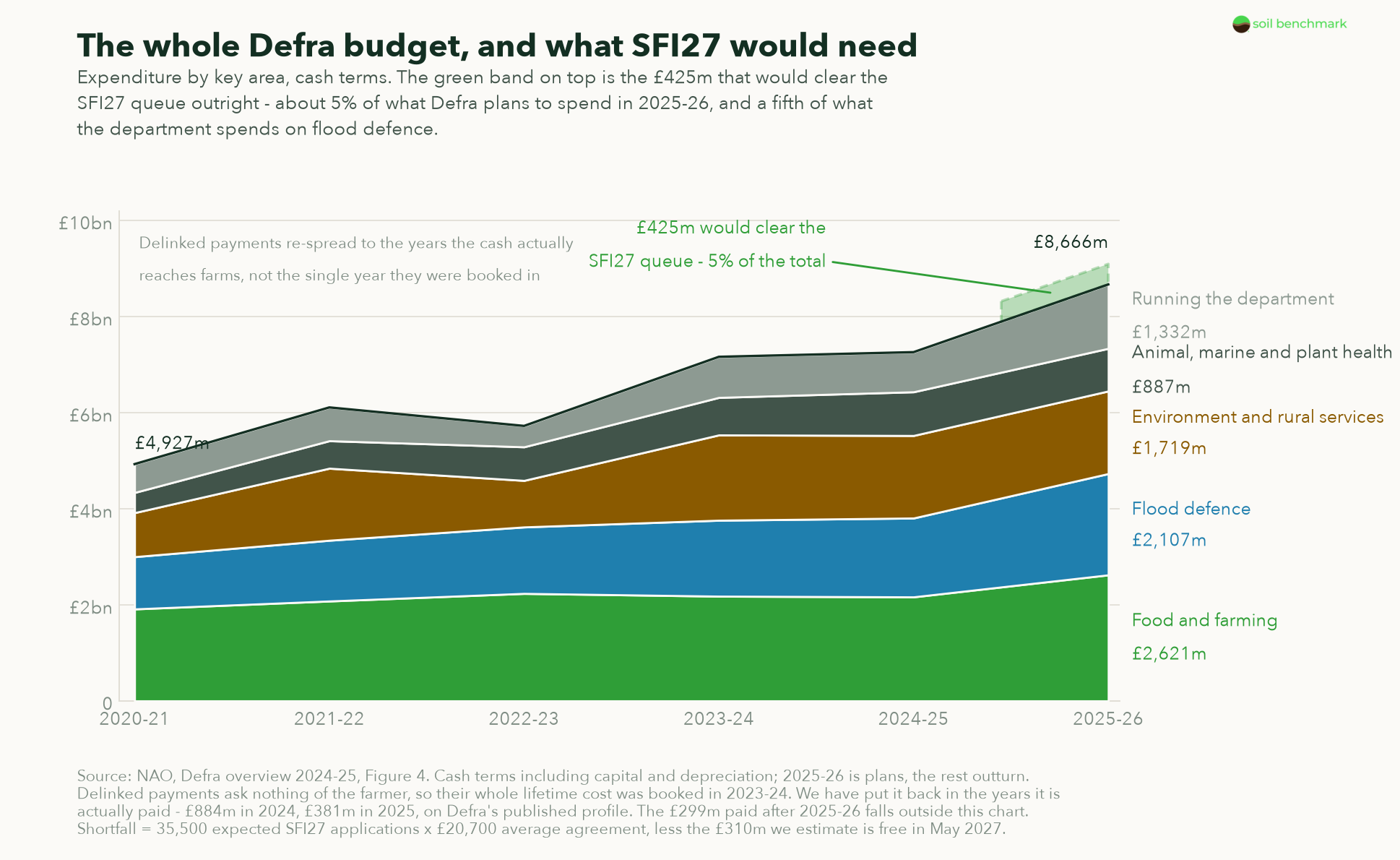
That last one got more topical this week. The Conservatives have proposed abolishing the Environment Agency and Natural England, who spent about £1.75bn between them last year. If you are taking the stick away, spending some of it on the carrot would at least be coherent.
So what would I do?
Three things, in order:
- Measure the demand first. An expression of interest round linked to SBI would tell DEFRA the real size and shape of it before they fix rates and caps.
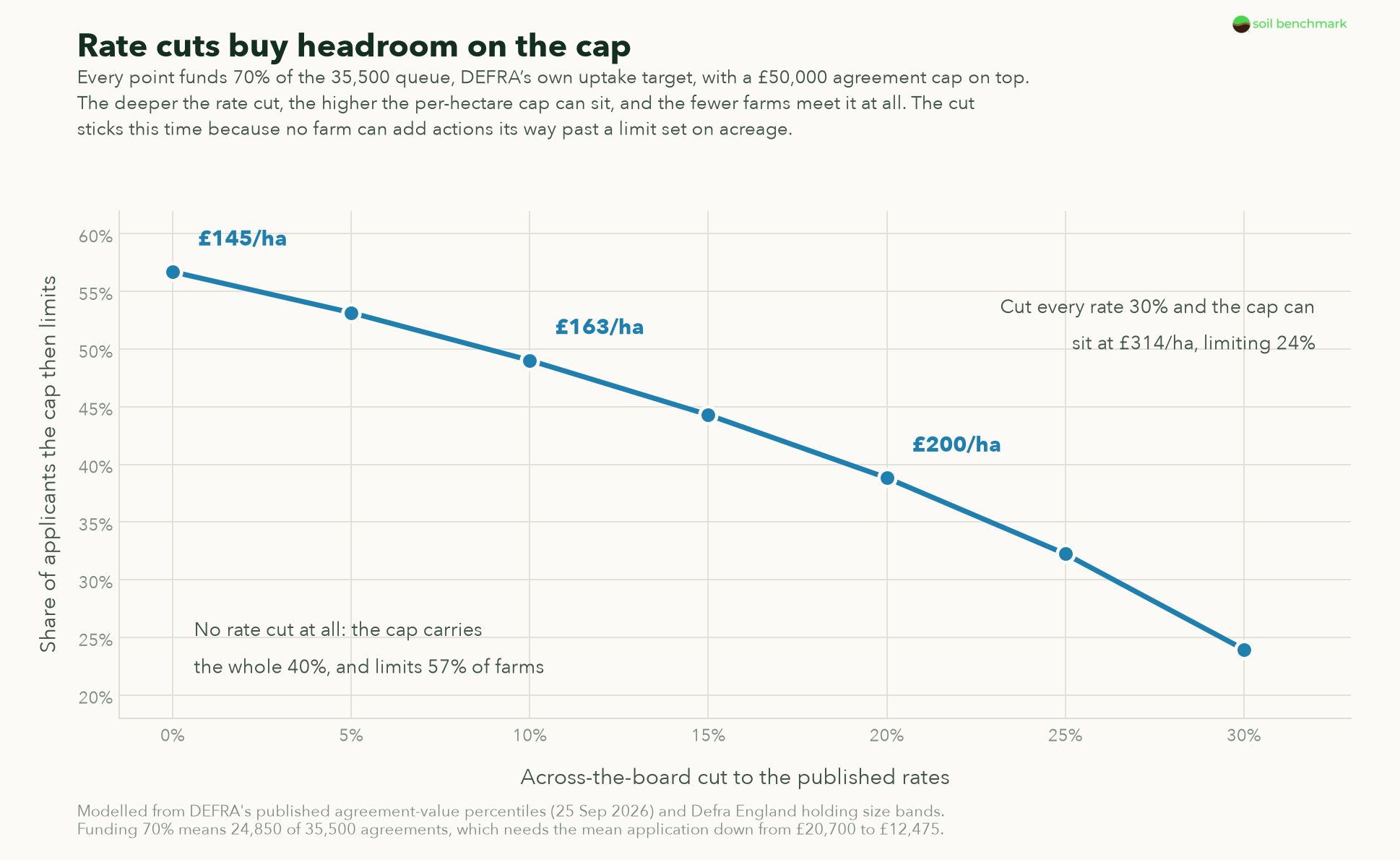
- Ration on area, not business size. A per hectare cap with a £50,000 agreement cap on top. DEFRA's own target is 70% of farms in schemes by 2028, and funding 70% of this queue means getting the average application from £20,700 down to £12,475.
- Start exploring more spatial monitoring and reporting of SFI, so that future iterations could be more targeted.
We are building out our SFI Shepherd module to be a one-click SFI (and Red Tractor) compliance tool, that produces and collates all the evidence you need, with easy prompts where more info is needed. It's part of Soil Benchmark's move into whole farm management software: nutrient management, spray plans, costing and stock are all now live alongside our original soils module. Sign up to our next webinar to find out more.