After last Tuesday's chaotic SFI26 Window 2, there's been lots of talk about a potential SFI27 for those who missed out - and on Wednesday DEFRA confirmed they are working on one, and looking at alternatives to the first come, first served model that drove the scramble. On Friday they published the detailed data on what people actually applied for.
Off the back of this and other DEFRA data, I've had a go at working out when a next round might come, how big it could be, and how they might avoid it descending into chaos again.
Two things stood out. On the budget, SFI27 could open as early as May next year - that looks like the first point there is enough money free for a round the size of SFI26. And the detail of what people applied for in Window 2 held some real surprises, which point to what DEFRA would have to change to stop the next one descending into the same scramble.
✴️ 1. Working out the budget
It's possible to estimate the budget coming free for DEFRA to reinvest, by looking at when existing agreements expire. DEFRA's quarterly snapshots showed 13,900 SFI23 agreements already running by April 2024, rising to 25,200 by that October when the scheme closed to new applicants. They run for three years. So that first block reaches the end of its term between this autumn and next spring, while the 11,300 that came later run on into mid-2027.
Value the slice ending by February at what DEFRA's payment data shows these agreements being paid and you get roughly £190m a year. Countryside Stewardship agreements almost all run to 31 December, and the cohort ending this year looks like another £120m or so - though DEFRA publish no start-year breakdown for CS, so that half is modelled rather than counted.
That is £310m 💷. Which, surprise surprise, was the size of the two SFI26 windows combined - though only after two top-ups. SFI26 was originally announced as £240m, £60m for Window 1 and £180m for Window 2. The Prime Minister added £50m in August, and DEFRA added another £20m on Tuesday itself when the scramble became clear, which they had obviously had ready up their sleeve.
So when you look at the schemes expiring after February, I think we can fairly estimate the SFI budget over the next few years.
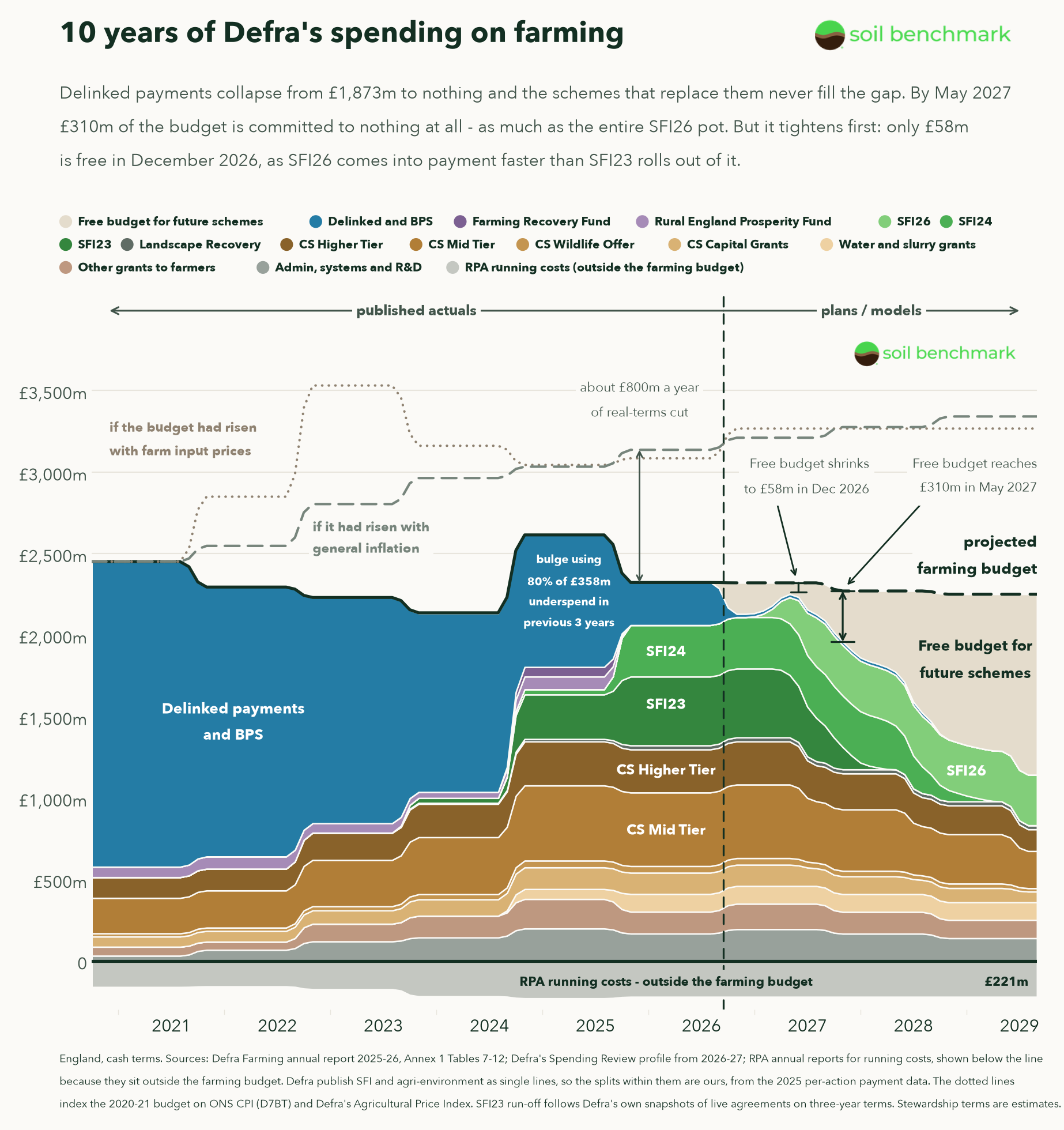
The black line is the total proposed farming budget (which is actually set to fall a little in cash terms over the next few years - about 9% in real terms by 2028-29). Below it are the amounts committed to schemes still running, so the gap between the two is what, in theory, will be useable for SFI27 and other future schemes.
By May 2027 the free budget gets back to £310m, and £709m by January 2028. DEFRA have said they want to open SFI27 as early as possible, so if they wanted it the size of SFI26, May 2027 looks like the first point there is a round's worth of money again.
✴️ 2. Would that be enough?
Almost certainly not ⚠️. Before the window we estimated about 40,000 farms wanted in. 12,200 managed to apply, which would mean an estimated 27,800 missing out. Add the farms whose agreements expire after February and I expect the queue will reach 35,500 farms by May 2027.
A £310m round funds about 15,000 applications at the average Window 2 agreement size of £20,700. So a May round would cover about 42% of the queue.
However, it's worth noting that plenty of farms reported trimming their applications on the day to get them in before the money ran out. So the £20,700 is the average of what got submitted, not of what people actually wanted. If what they wanted was 10% higher, a May round would cover only 39% of the queue rather than 42%.
And simply waiting for more money to come free does not fix it. Whenever DEFRA open SFI27, the money freeing up never catches up with the queue: we estimate 2.4x oversubscribed in May 2027, still 1.4x by mid-2028. In other words, with the current budget demand will continue to far outstrip supply.
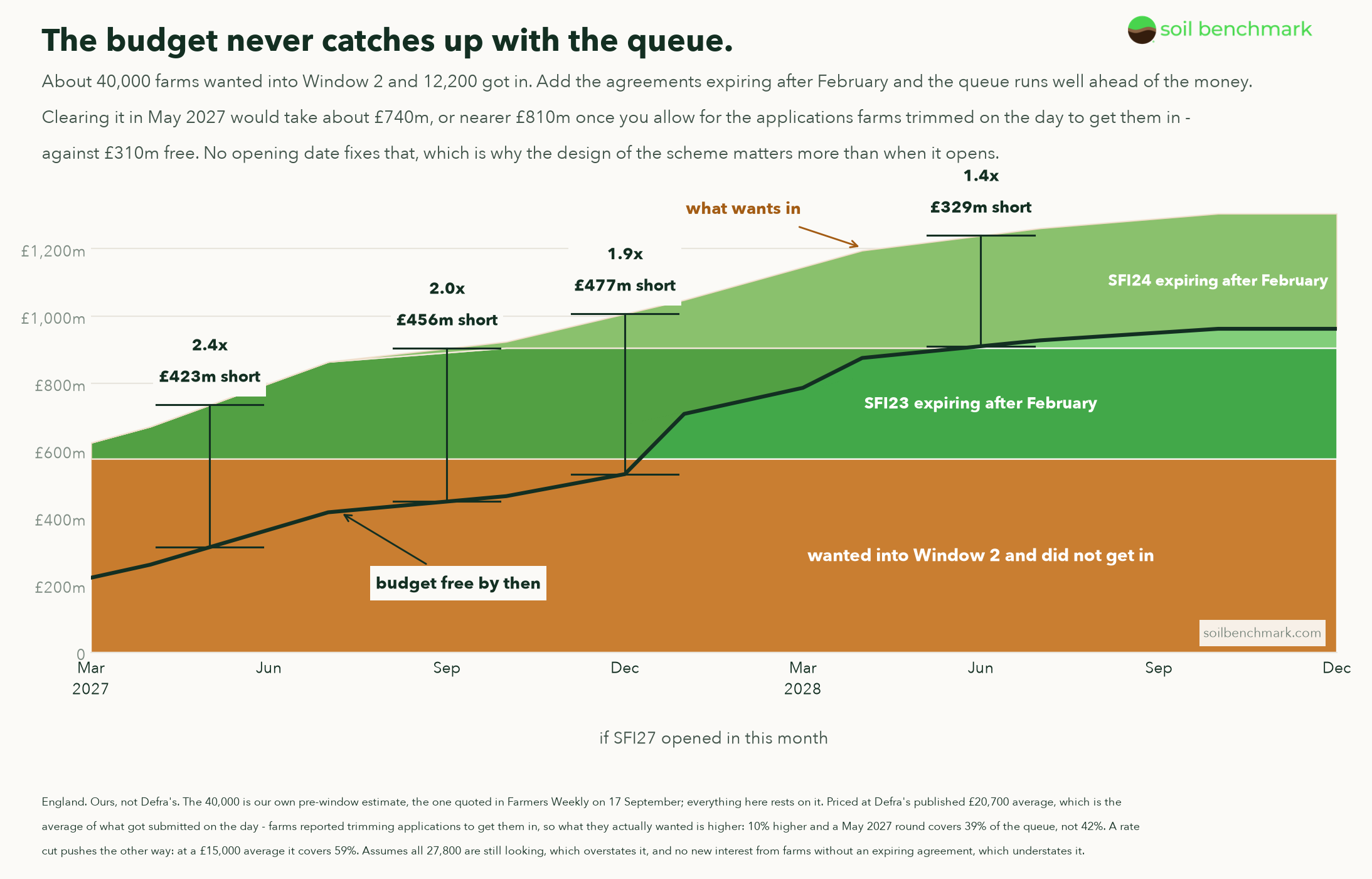
To actually meet the demand, I estimate a May SFI27 would need a budget of at least £740m rather than £310m. Assuming that extra budget is unlikely to be forthcoming from an overstretched and sceptical Treasury, the focus for DEFRA will have to be on re-designing SFI to cope with the huge latent demand.
✴️ 3. Two things that might help
There have been many suggestions made, but here are three ideas I think could help. The first would be to avoid running SFI again as one annual auction 🎟️. Given the available budget keeps increasing every month as SFI23 and 24 agreements conclude, perhaps SFI27 should open on more of a rolling basis, with a window each month to claim a budget linked to the size of the old agreements that have just ended.
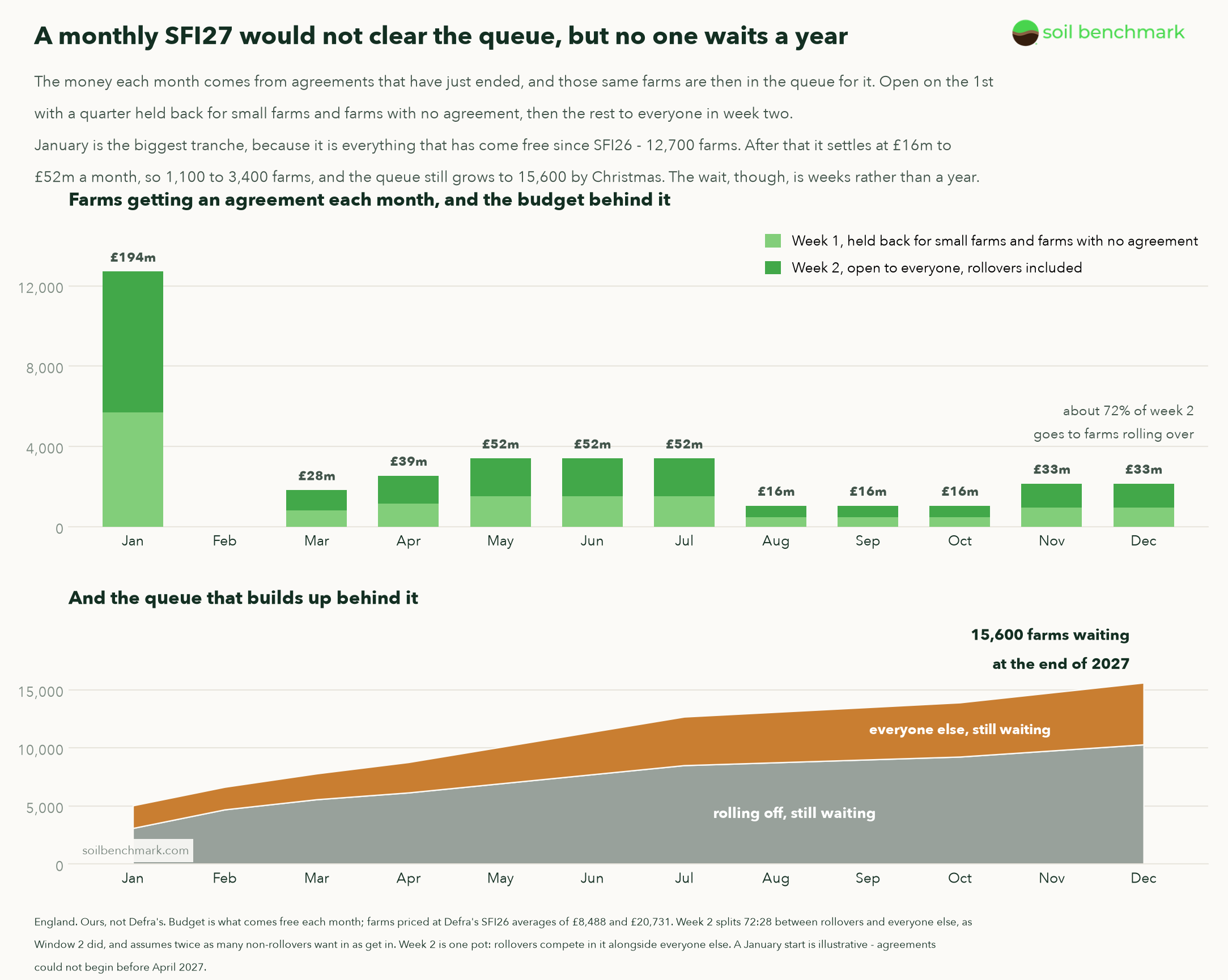
Each monthly window could even build in the successful innovation from SFI26 whereby they made a quarter of the budget available early for those who are not just big farms (often with agents) rolling over existing agreements. SFI26 Window 1 achieved this. 85% of Window 1's applicants had no agri-environment agreement at all - no SFI, CS or ES. In the open Window 2 it was just 10%. In total 6,891 farms with no previous agreement got into SFI26, and 83% of them came in through Window 1.
So each month it could open on the 1st, with a quarter of that month's budget, just for small farms and farms with no previous agreement, and a week later open with the remaining budget to everyone else. DEFRA could keep the budget warnings at 25%, 50% and 75% as each month's money went. Anything unspent would roll into the following month.
It would still be heavily oversubscribed, and you can see in the chart above the queue still building through 2027. But a farm that missed out in one month would only wait a few weeks for the next go rather than a year, which could take out some of the pain of being oversubscribed without needing a penny more.
The second lever would be to cut payment rates across the board ✂️. That would be unpopular with farmers already furious with Defra, but might help for two reasons: the same money covers more farms, and slightly lower rates would take a little heat out of the demand at the same time. However, Window 2 shows that DEFRA should be careful to avoid simply cutting rates for a few popular actions, as they did this time, because farms just took more actions instead and the budget went no further (see below).
A third idea 💡, which I floated last week: why can't private funding top up the SFI budget, with donors claiming a share of the DEFRA-modelled benefits for their own carbon balance sheet rather than the government's? The actions, the monitoring and the evidence are all there already.
✴️ 4. What people actually picked
As expected, the difference in farm types made different actions popular in each window. Window 1 was mostly small grassland farms, and it shows: low input grassland (CLIG3) in 72% of applications against 40% of SFI24 agreements, hedgerow management (CHRW2) 40% against 29%, the haymaking supplement (GRH7) 25% against 10%.
77% of applicants to Window 2 were farms over 50ha that were rolling over from an existing SFI23 or CS agreement, and the arable actions climb accordingly. Winter bird food (CAHL2) was in 22% of Window 2 applications against 6% in Window 1, which puts it back above where it was in SFI23 (18%) and SFI24 (13%). No insecticide (CIPM4) recovered to 22% against 10% in Window 1 (although it was 31% in SFI23).
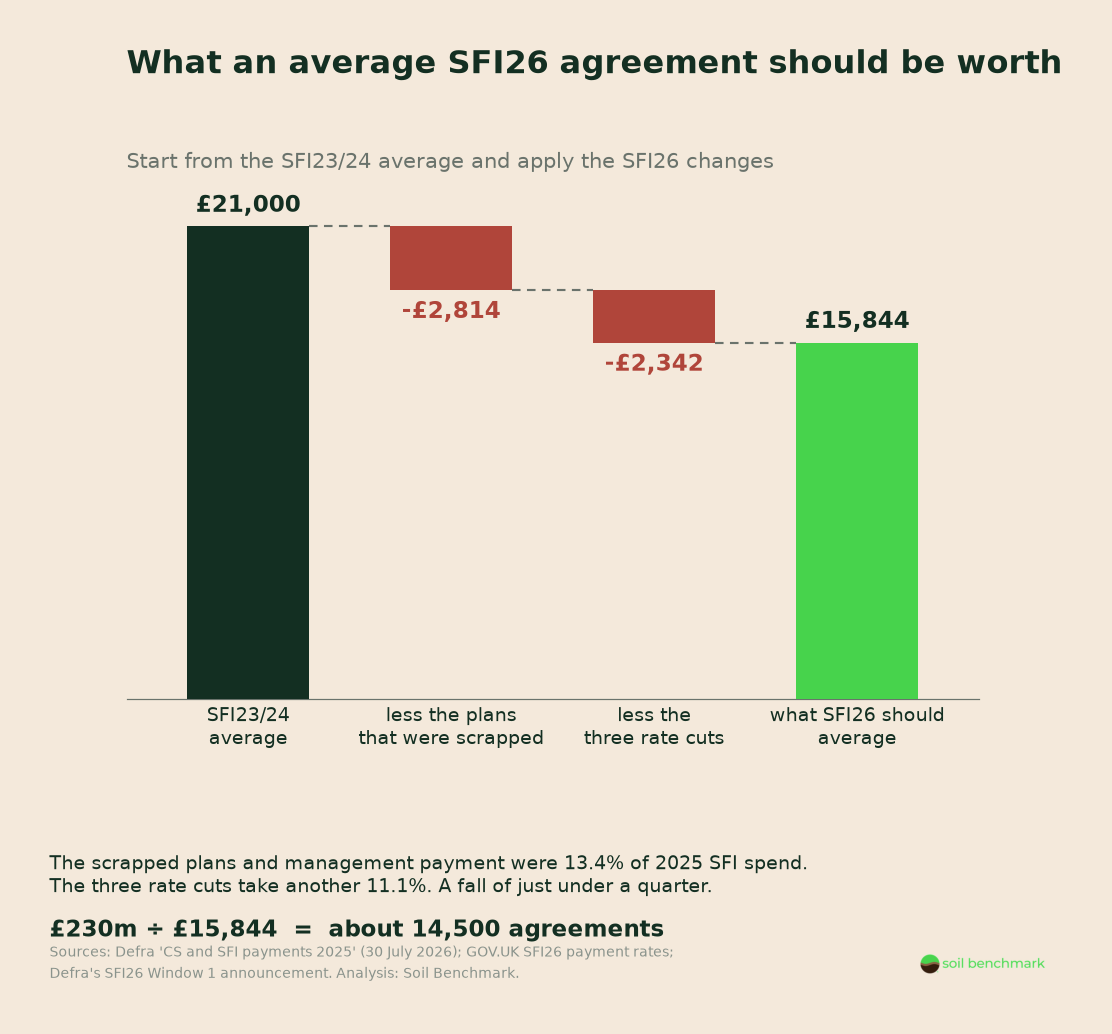
What did surprise me was that the size of Window 2 agreements actually rose against SFI23 🌾. The four most-used SFI23 actions have all gone, taking the management payment and every planning action with them, and rates were cut on three of the bigger survivors. I had expected the average to fall about 28%, to somewhere near £15,000. It came in at £20,700.
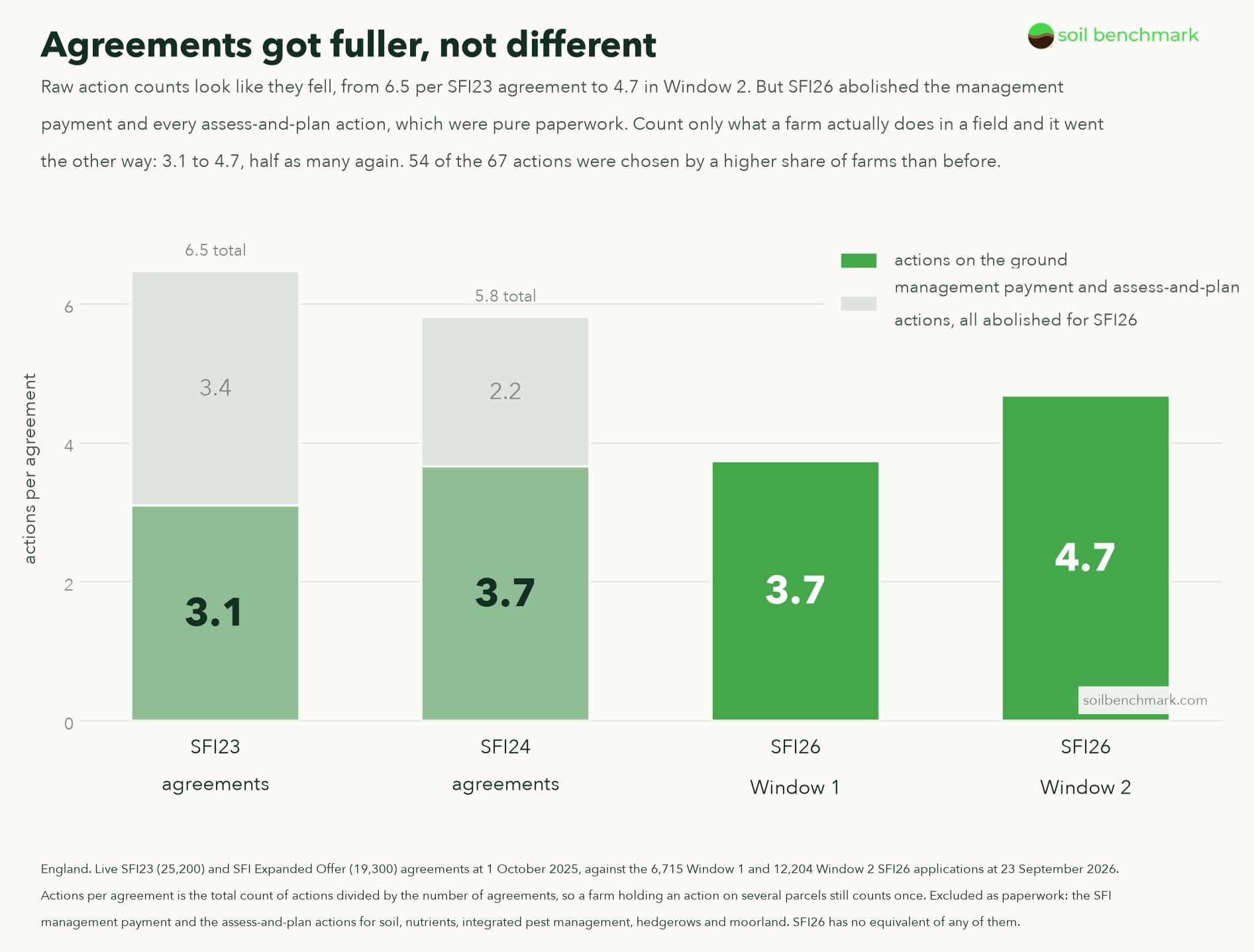
Which is part of why the money went so quickly: about 12,000 agreements rather than the 15,000 I had guessed at.
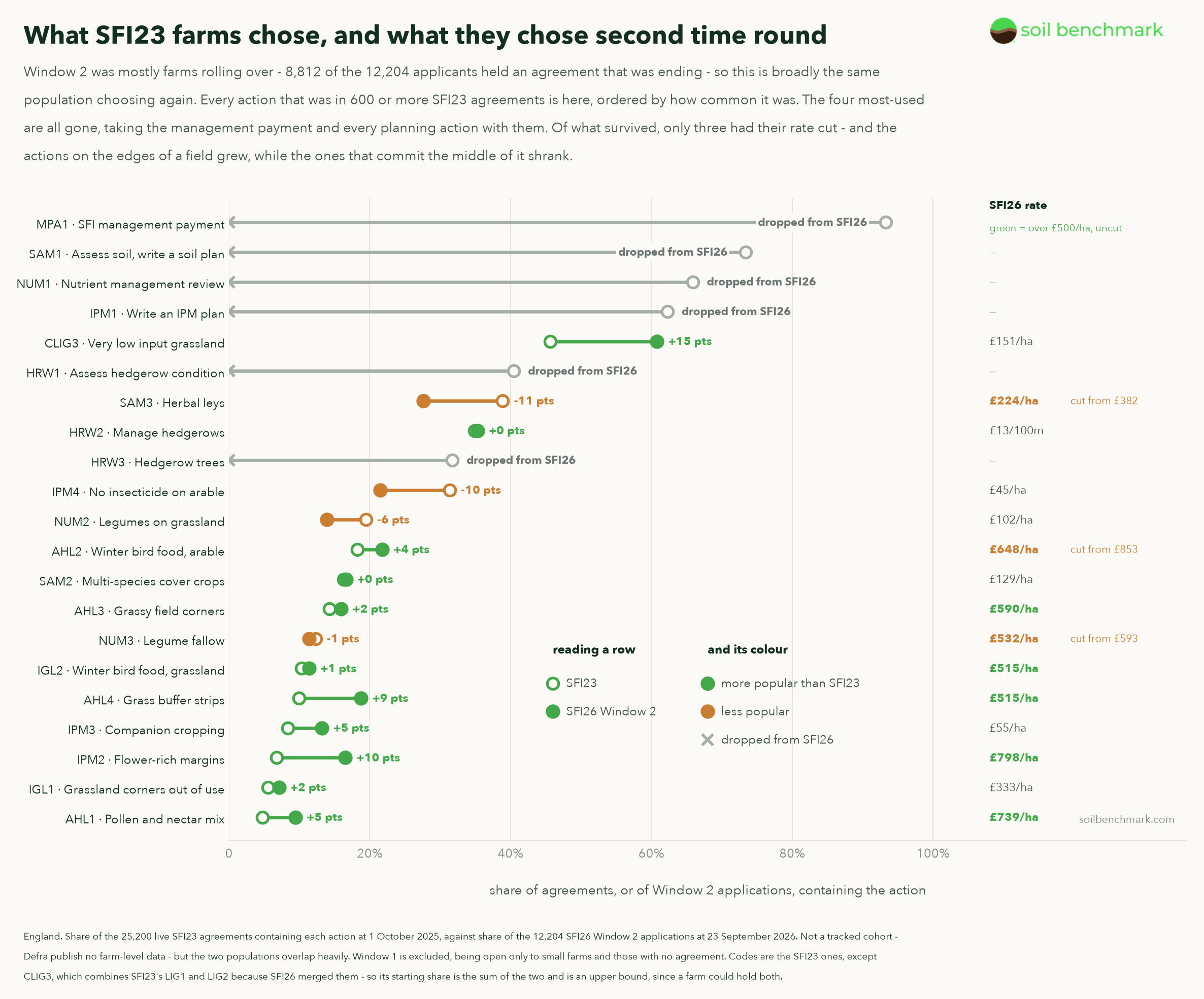
They managed it by simply taking more actions. Strip out the management payment and the planning actions that SFI26 abolished, and the average agreement went from 3.1 actions in SFI23 to 4.7 in Window 2. 54 of the 67 actions were chosen in a higher share of agreements. It looks like a case of fill your boots - no one knows where SFI goes next, so farms took what they could while it was there. Low input grassland (CLIG3) rose most of all, up 15 points to 61% of applications. Behind it, the sharpest risers were the high payers that had escaped a rate cut:
- ↑ Flower-rich margins (CIPM2) - 7% to 17% of applications, £798/ha
- ↑ Grass buffer strips (CAHL4) - 10% to 19%, £515/ha
- ↑ Pollen and nectar (CAHL1) - 5% to 9%, £739/ha
Only four of the surviving SFI23 actions actually fell:
- ↓ Herbal leys (CSAM3) - 39% down to 28%, after a 41% rate cut, £224/ha
- ↓ No insecticide (CIPM4) - 31% down to 22% of agreements, £45/ha
- ↓ Legumes on improved grassland (CNUM2) - 19% down to 14%, £102/ha
- ↓ Legume fallow (CNUM3) - 12% down to 11%, after a 10% rate cut, £532/ha
The three rate cuts land in order of size. Herbal leys took 41% off and is the only action to fall sharply. Legume fallow took 10% and slipped a little. Winter bird food took 24% and still grew, so a cut on its own did not drive farms off.
And that is only half the picture - only 16 of SFI26's 71 actions were in SFI23 at all. The other 52 arrived with SFI24, the Expanded Offer. Rank the lot by how far each one moved and the same thing shows up: 33 of the 40 sizeable actions rose. The seven that fell are all cheap ones - dry stone walls and earth banks at £27 and £11 per 100m, ditches at £4, no insecticide at £45 - plus herbal leys, which took a 41% rate cut.
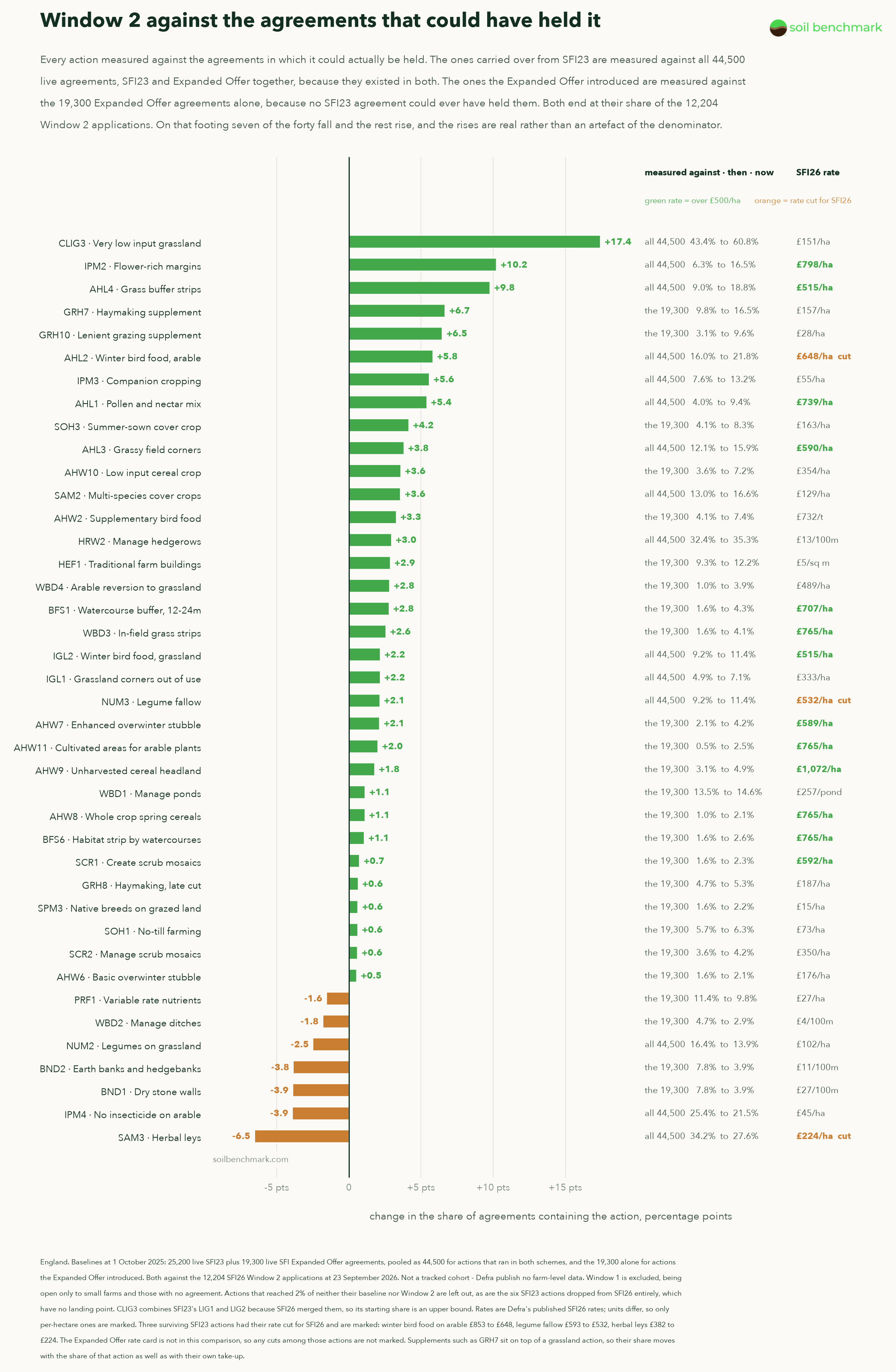
So, as noted above, cutting rates of the most popular actions did not cut overall SFI demand or stretch the budget to cover more farms. Farms were clearly still keen to maximise dependable SFI revenues as the increasingly erratic climate means the income from food production becomes more unreliable.
Given how oversubscribed Window 2 was, and the need to make the budget stretch further, I would expect DEFRA to cut rates again for SFI27. Perhaps they will simply cut rates across the board rather than action by action, to avoid the same situation of farms simply adding more actions to make up the difference. There is a floor somewhere: cut below what an action actually costs a farm and demand falls off a cliff. But given the scramble we have just seen, my guess is they could cut a fair way before a round failed to sell out. SFI income has become an important and reliable part of farm cash flow, especially after a torrid season.
✴️ 5. So where does that leave SFI27?
There should be enough money by May 2027 for another round the size of SFI26, if that is what DEFRA want. But it would likely result in another mad rush with lots of 'have nots' who miss out for another year as they are unable to apply within a short window. They might be better off with a regular series of smaller rounds, so that missing out is a few weeks' wait rather than one stressful day that you either win or lose. And I would expect rate cuts across the board, to make the money go further given the demand.
One thing worth knowing if you missed out. The biggest gap in all of this is CS Higher Tier, which is open - and worth a look, since there is now an expression of interest route rather than waiting to be invited. There is little published take-up data for it, which is why I can't size it.
On our side, good to see SFI Shepherd getting so much use even though we only launched it a few short weeks before Window 2 opened; we'll keep on improving it ready for whenever SFI27 comes. The wider point is that Soil Benchmark has now developed into whole farm management software, more akin to Gatekeeper or Omnia, so hopefully it is an easy place to manage SFI compliance - so many of the actions need to tie into your existing soil, nutrient and spray planning anyway. If you're interested in everything we have built this year, our next webinar is on 21st October.