How to turn RB209 into an actual fertiliser plan: soil indices, crop requirements, organic manure allowances, and why Scotland does phosphorus differently.
What RB209 is, and how to use it
What RB209 actually is
RB209 is the AHDB Nutrient Management Guide, and it's the reference standard behind almost every nutrient obligation in England and Wales. Red Tractor asks for plans built on RB209 or an equivalent. The Farming Rules for Water expect applications planned against crop need, and RB209 is how you evidence what that need is. SFI nutrient management asks the same.
It's organised into sections - the principles, organic materials, grass and forage, arable crops, potatoes, vegetables, and fruit. Most arable farms live in two of them. Scotland uses a different system, covered further down.
The method, in order
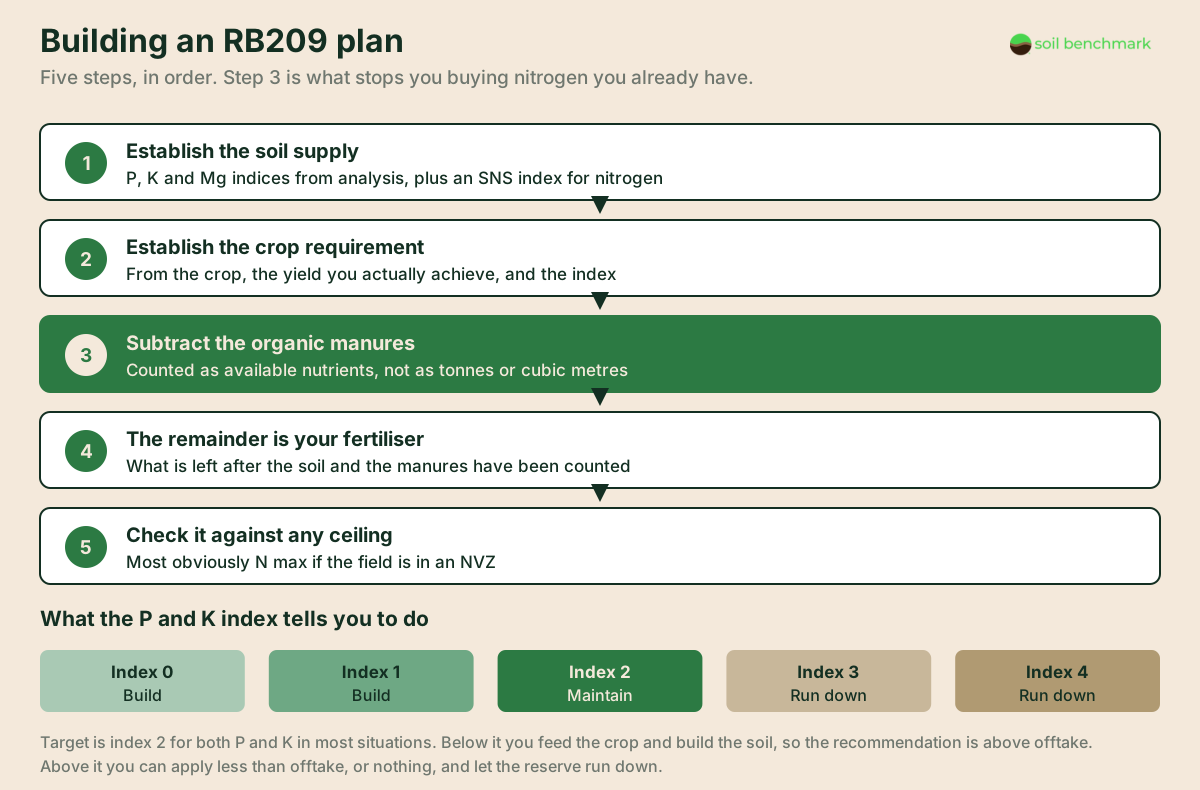
RB209 works as a sequence, and the order matters.
Establish the soil supply. An index for P, K and Mg from analysis, and an SNS index for nitrogen.
Establish the crop requirement. From the crop, the expected yield and the index.
Subtract what the organic manures will supply, as available nutrients.
The remainder is the manufactured fertiliser.
Check it against any ceiling that applies, most obviously N max in an NVZ.
Step 3 is the one worth taking time over. Count what the manures actually supply and you stop buying nitrogen the field already has, and an inspector can see the arithmetic behind the rate you applied.
Reading your soil analysis
Soil indices for P, K and Mg
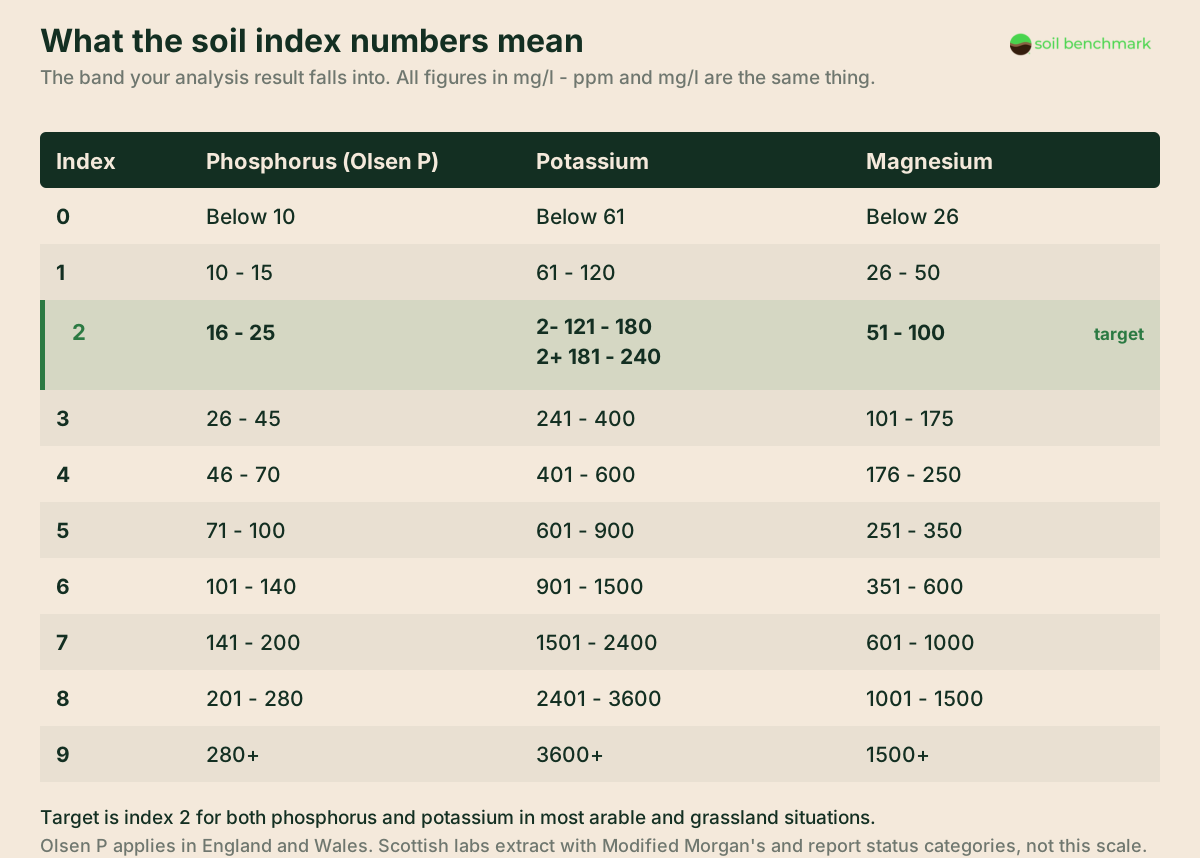
Analysis gives a figure in milligrams per litre, which maps to an index from 0 upwards. The target for both P and K is index 2 in most arable and grassland situations. Our soil sampling guide covers how to get a result worth building on, and why pH gates everything else.
At index 2 you're applying maintenance - roughly replacing what the crop removes.
Below index 2 you're feeding the crop and building the soil, so the recommendation is above offtake.
Above index 2 you can apply less than offtake, or nothing, and let the reserve run down. On a field at index 3 or 4 that's real money if you keep applying maintenance out of habit.
Potassium is the one to look at twice. It's the only nutrient RB209 splits within index 2, into 2- and 2+, and the recommendation differs between them. A result of 130 and a result of 230 are both "index 2" in conversation, and RB209 treats them differently.
Running an index down is a judgement call rather than an instruction. RB209 will tell you to apply nothing on a field at index 3, and plenty of growers would rather come down more slowly than that, particularly on land they've spent years building up or if you have large amounts of slurry or manure to dispose of. In Soil Benchmark you can override any recommendation by hand for exactly that reason - the plan then carries your figure, with the RB209 number alongside it, so an auditor can see what you did and why.
Either way the application still has to meet crop need and stay under any ceiling that applies, N max included. Having muck to place is a sound reason to put it where the crop can use it. On its own it isn't a justification for the rate, and it's the one an inspector hears most often.
Magnesium works the same way but the target is usually index 2 as well, and it interacts with potassium - high K can induce Mg deficiency even when the Mg index looks adequate.
An index is a band, not a point. A field can sit at the bottom of index 2 for years while you apply maintenance dressings and never move. If you're trying to shift an index, look at the actual milligrams per litre rather than the band.
Nitrogen and the SNS index
Nitrogen doesn't work off a standard soil analysis, because mineral nitrogen moves. RB209 uses a Soil Nitrogen Supply index, arrived at one of two ways:
The field assessment method, which uses previous cropping, soil type, rainfall and organic manure history to place the field in an SNS index. This is what most farms use.
Measurement, by sampling for soil mineral nitrogen. More accurate, more expensive, and worth it where the field assessment method is likely to be wrong - after a ploughed-out ley, heavy manure history, or an unusual season.
The nitrogen recommendation then comes from the crop, the expected yield and that SNS index. If the field is in an NVZ, the answer still has to sit under N max - see the NVZ guide.
Manures, sulphur, pH, advisers, Scotland, and where plans go wrong
Counting organic manures properly
An inspector will check this, and plenty of plans get it wrong. A manure application has to be counted as available nutrients, not as tonnes or cubic metres. How much of the nitrogen is actually available depends on:
The material. Slurry, poultry litter and digestate have a high readily available nitrogen fraction. Farmyard manure and compost are much lower and release slowly.
Dry matter. Slurry at 2% dry matter and slurry at 8% are different products.
Timing. Autumn-applied nitrogen is largely lost before the crop wants it. The same load in spring supplies far more.
Application method and incorporation. Broadcast and left on the surface loses ammonia to the air. Band spread, injected or promptly incorporated keeps far more of it.
The RB209 standard values get you a long way, but analysing your own manures is cheap and those tables cover a wide range - your material could sit at either end.
Sulphur
Sulphur has changed. Atmospheric deposition has fallen away, so deficiency is now common rather than rare, particularly on light and shallow soils and in oilseed rape and grass silage. It isn't a routine soil test, so it tends to be managed on risk.
pH sits underneath the whole plan
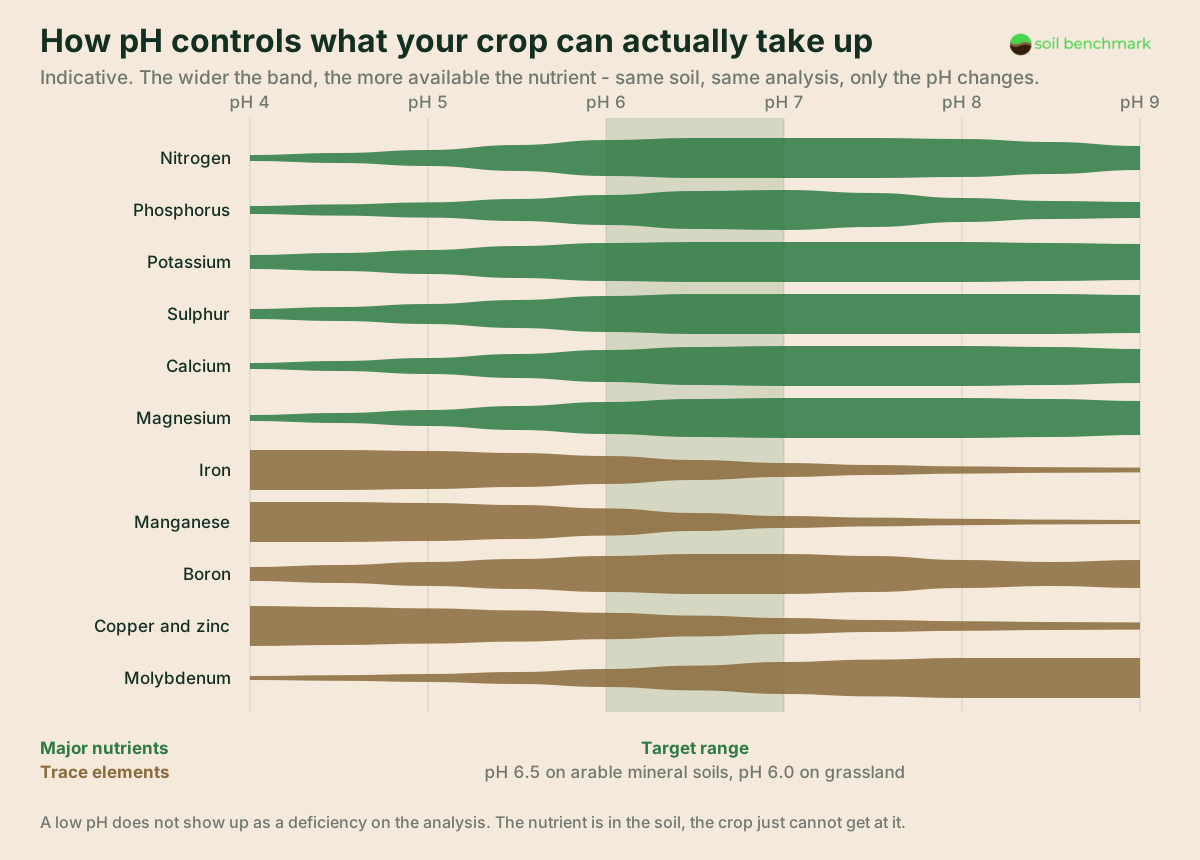
An RB209 recommendation assumes the crop can actually get at what's in the soil, and pH decides that. Get it wrong and you can follow RB209 exactly and still see a deficiency in the crop.
Targets are pH 6.5 on arable mineral soils and pH 6.0 on grassland. Correcting pH is usually cheaper than the fertiliser it lets the crop use.
When you need a FACTS qualified adviser
There's no general legal requirement for a qualified adviser to sign off a nutrient plan. You can work through RB209 yourself. It becomes a requirement scheme by scheme:
SFI NUM1 and CNUM1 required it outright. A member of the BASIS Professional Register qualified under the Fertiliser Advisers Certification and Training Scheme had to visit the farm, do the assessment and help produce the review report, in the first year and again in each subsequent year, unless you were FACTS qualified yourself. See our SAM1 and NUM1 guide.
Red Tractor expects nutrient advice from someone suitably qualified, and FACTS is the recognised benchmark. Some stewardship rules go further and ask specifically for agronomic justification from someone FACTS qualified, urea timing being the usual example.
Buyers, processors and scheme applications increasingly ask who wrote the plan, which in practice means the same thing.
Departing from RB209
RB209 is guidance, not law. The Farming Rules for Water require applications planned to meet soil and crop need, and Red Tractor asks for RB209 or an equivalent recognised standard. Neither of them says the number in the table is the only permissible answer.
So a suitably qualified adviser can recommend outside the standard figures where there's an agronomic reason - a higher rate for a crop with a genuine prospect of the yield, a different split, a nutrient the tables handle thinly. What makes it defensible is that it's signed off by someone qualified and the reasoning is written down at the time, not reconstructed later.
An unexplained departure is what gets picked up, because on the face of the record there's nothing to separate it from applying whatever suited you.
Scotland doesn't use RB209
Scotland works to the SAC Technical Notes published by SRUC. Don't assume a Scottish result and an English one mean the same thing.
The soil test itself is different. Scottish labs extract phosphorus and potassium using Modified Morgan's. England and Wales use Olsen P. The two aren't interchangeable, so an RB209 index read off a Modified Morgan's result is meaningless. Scotland also reports P and K as status categories rather than the 0 to 9 index scale.
Phosphorus is adjusted for the soil's ability to hold on to it. There's no RB209 equivalent to this. SRUC has mapped every non-calcareous soil association in Scotland to a Phosphorus Sorption Capacity index:
PSC 1 - low sorption. The soil gives phosphorus up readily.
PSC 2 - medium.
PSC 3 - high sorption. The soil locks phosphorus up, so you need more of it in the soil to keep the same amount available to the crop.
The target moves with the PSC. For cereal-based arable rotations and established grass and clover swards, the target soil P status is lower moderate (M-) on PSC 1 and 2 soils, and upper moderate (M+) on PSC 3 soils. Two fields with identical P test results can carry different recommendations purely because of the soil association they sit on. There are also regional Technical Notes for phosphate and potash, so the right note depends on where the farm is.
Where plans go wrong
Yield expectations that flatter the farm. The requirement scales with yield. Plan on a yield you actually achieve.
Indices too old to rely on. Five years is the outside limit, and a lot changes in five years of manure applications. See the soil sampling guide.
The plan and the reality diverging. The plan is written in January, the season happens, and nobody updates it. Records of what was actually applied matter as much as the plan.
Ignoring pH. A field at pH 5.5 won't use the phosphate you apply. Liming is often the highest-return nutrient decision on the farm.
Last checked 28th August 2026. Rules and recommendations change - check the source before relying on a figure.
Building a nutrient management plan
RB209 recommendations, with the manures counted properly
Nutrient Nerd builds the RB209 plan for arable and grassland, counts organic manures as available N, P, K and S rather than tonnes, and checks closed periods, N max and field limits as you plan rather than afterwards. It produces linked job sheets for whoever's spreading, and a compliance certificate you can show inspectors or the supply chain.