Soil sampling: how often and what to test
Guide

Soil sampling: how often and what to test

How often to sample, what each scheme in England, Wales and Scotland actually requires, how to take a representative sample, and what the results mean for your nutrient plan.

Why sampling comes first, and how often to do it

Why sampling comes first

Almost every soil and nutrient obligation you've got starts with an analysis result. RB209 recommendations need a P, K, Mg and pH index. Red Tractor wants analysis on a regular cycle. The Farming Rules for Water require your results to be no more than five years old at the time of application.

It's worth knowing what each scheme asks for before you book anyone in, because the requirements differ more than you'd expect between England, Wales and Scotland, and they've all changed recently.

How often

The working standard is at least once every five years for each field or sampling unit. That's what the Farming Rules for Water require in England and what RB209 assumes.

Sample more often where it earns its keep:

  • Every three to four years on light land, on fields with variable yields, or where you're correcting a low index and want to see it moving.
  • Before a rotation change, particularly going into a crop with a different P and K appetite, or into a legume where pH matters more than people expect.
  • After a run of heavy organic manure applications, where P can climb faster than you'd think.
England
  • Farming Rules for Water. pH, phosphorus, potassium and magnesium, no more than five years old at the time you apply. This applies to everyone farming in England, in a scheme or not.
  • SFI SAM1 and CSAM1. On top of the standard suite, soil organic matter on every parcel entered into the action, tested within the last five years, and kept within five years for the whole of the three year agreement. Retest land as its result reaches five years old. You can take the samples at the same time as your routine Farming Rules for Water analysis.
  • Both actions are closed to new applications and neither is in SFI26, but agreements already running still carry the requirement. See our SAM1 and NUM1 guide.
  • SFI26 has no soil testing action at all. Nothing in the new offer pays for sampling.
Wales

The Sustainable Farming Scheme made soil testing a universal action, UA1 Soil Health. It applies if you claim on field parcels containing improved land, meaning land that has been reseeded, or limed, or has had inputs.

  • A minimum of 20% of your fields containing improved land tested in 2026, or tested in the previous five years.
  • From year 2, an average of 20% a year, so every parcel is covered within a five year cycle.
  • From 1 January 2026 the analysis must cover P, K, Mg, pH and soil organic matter as a minimum, at an accredited laboratory. Send all your samples to the same lab so the results are comparable.
  • Testing done after 1 January 2022 counts towards it, and only had to include P, K, Mg and pH.
  • Each year's testing must be finished by 31 December, and results kept on farm for at least five years.
  • From 1 April 2026 Farming Connect no longer funds the testing for farms in the scheme, though it still helps interpret the results.
Scotland

Soil analysis is one of the five baselines in the Whole Farm Plan, alongside an animal health and welfare plan, a biodiversity audit, a carbon audit and an IPM plan.

  • Two of the five were required by 15 May 2025. All of them are required by 15 May 2028.
  • Soil analysis applies to Region 1 land you manage permanently and put artificial fertiliser or organic manure on. Seasonal land and common grazing shares are out.
  • Every applicable parcel sampled at least once every five years, and the result must include pH, phosphate, potash and carbon.
  • Falling short currently brings a warning letter rather than a cut to your Basic Payment.

Note that Scotland asks for carbon where Wales asks for organic matter. They're related but they aren't the same measurement, and labs report both, so check which one is on the certificate you're paying for.
What to test for, and how to take the sample

What to test for

The standard suite is pH, phosphorus, potassium and magnesium. That's what RB209 indices are built on and what an auditor expects to see.

Beyond that:

  • Organic matter or carbon. No longer an optional extra. It's required by SAM1 in England, by UA1 in Wales, and as carbon by the Whole Farm Plan in Scotland, and buyers and carbon audits ask for it too.
  • Sulphur, on light or shallow soils and anywhere you've had deficiency symptoms.
  • Micronutrients such as boron, manganese and copper, where you've got a specific crop at risk rather than as a matter of routine.
  • Soil mineral nitrogen, where you want a measured SNS figure rather than the field assessment method.

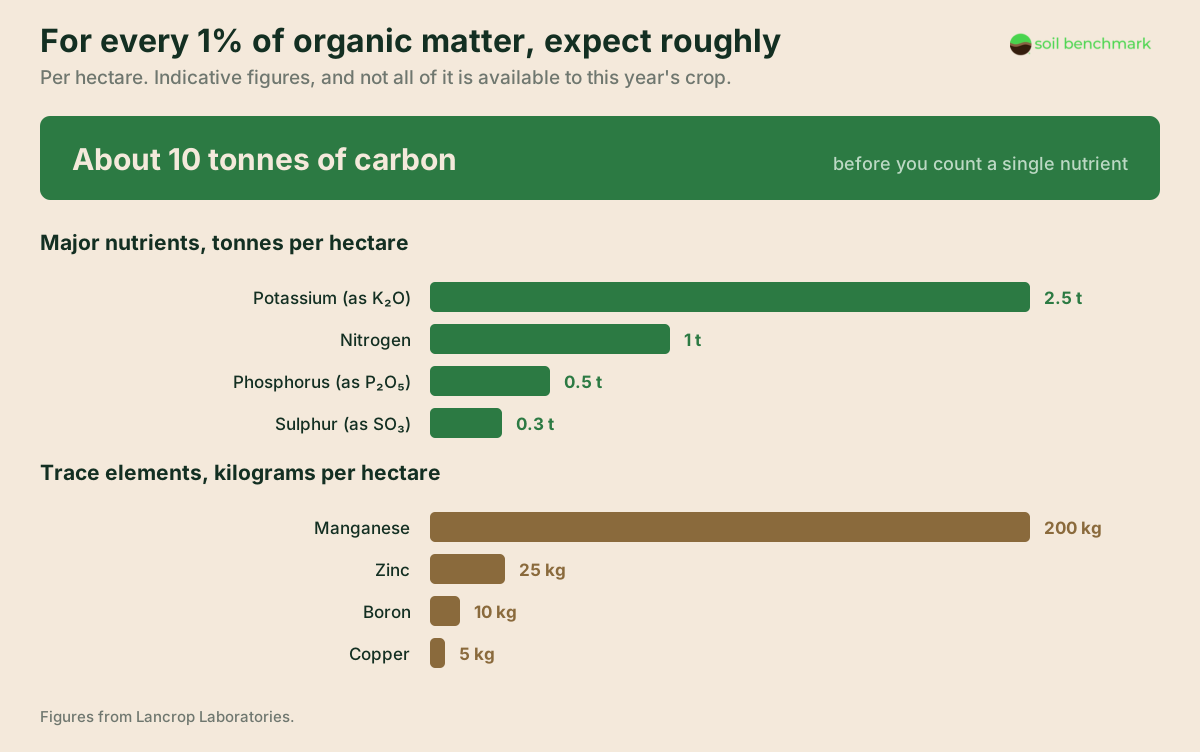
Organic matter is worth testing for reasons beyond the scheme rules. It's a nutrient store in its own right, and a percentage point of it is holding a good deal more than most people assume.

Chart of what to expect for every one per cent of organic matter, per hectare: about 10 tonnes of carbon, 2.5 tonnes of potassium as K2O, 1 tonne of nitrogen, 0.5 tonnes of phosphorus as P2O5, 0.3 tonnes of sulphur as SO3, and trace elements including 200kg of manganese

Those nutrients aren't all available to this year's crop, and they don't come off a plan the way a bag of fertiliser does. But they're the reason a field losing organic matter gets progressively harder to feed.

Taking a representative sample
  • Sample to the right depth - 15cm for arable fields and short-term leys under five years, 7.5cm for long-term grassland. Mixing depths between years is the most common reason indices appear to jump around.
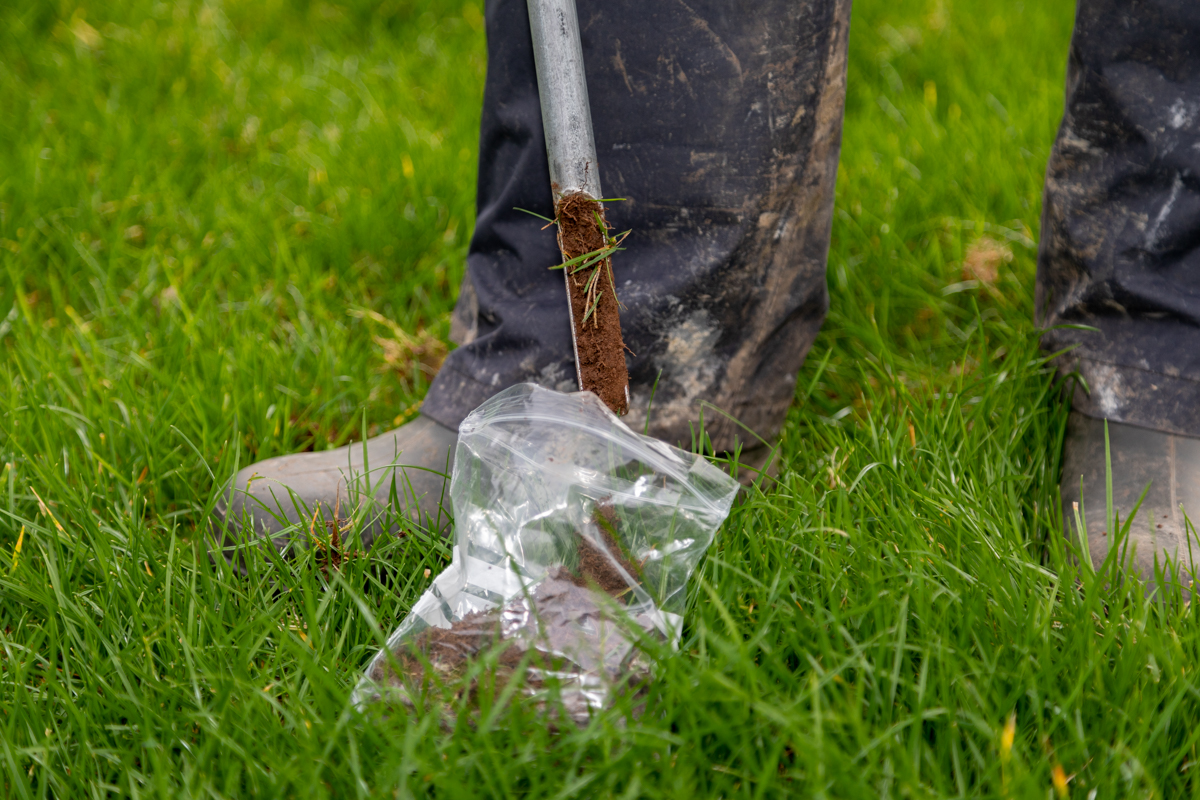
  • Walk a W or a zig-zag across the sampling area and take 20 to 25 cores, bulked into one sample.
  • Keep the sampling area sensible - up to about four hectares of genuinely uniform ground. If a field has two soil types, sample it as two units.
  • Avoid the obvious distortions - headlands, gateways, old muck heaps, tramlines, feeders and anywhere stock congregate.
  • Be consistent on timing. Same point in the rotation, same time of year, and not straight after liming or a fertiliser application. A spring sample and an autumn one aren't comparable, so the difference between them isn't a trend.

Reading the result, and keeping the evidence

Reading the result

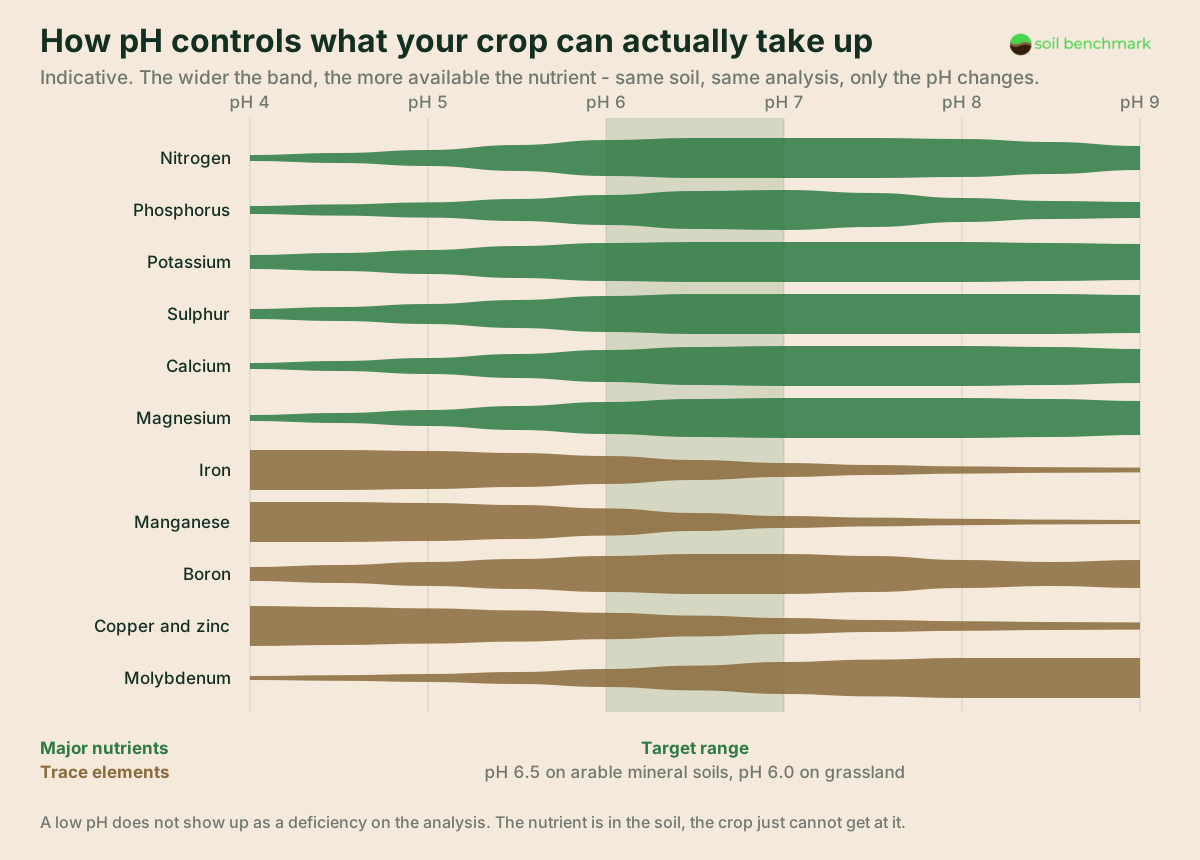
Start with pH. Nutrients that are present but locked up by a low pH won't show as a deficiency in the analysis, but they will show in the crop. The usual targets are pH 6.5 on arable mineral soils and pH 6.0 on grassland.

Chart showing how the availability of each nutrient changes across pH 4 to 9, with the major nutrients most available around pH 6.5 to 7 and the trace elements iron, manganese, copper and zinc most available in acid soils

It's the reason liming is so often the best-value nutrient decision on the farm. On a field at pH 5.5 you can be applying phosphate the crop can't reach, and the analysis will still say the phosphate is there.

Then the indices. RB209 works towards a target of index 2 for both P and K in most situations. Above target you can cut back and let the soil run down. Below it you're building as well as feeding this year's crop, so the recommendation is higher than offtake alone.

An index is a band, not a point. A field can sit at the bottom of index 2 for years while you apply maintenance dressings and never move. If you're trying to shift an index, look at the actual milligrams per litre rather than the band.

If you farm in Scotland

Scottish labs use a different extraction method, Modified Morgan's, where England and Wales use Olsen P. The results aren't interchangeable, and Scotland reports status categories rather than the RB209 index scale, so make sure whoever interprets your analysis is working to the right system. Our RB209 guide covers the differences, including how phosphorus targets move with the soil's sorption capacity.

Keeping the evidence

Hold on to the lab certificates themselves, not just the numbers typed into a plan. An auditor or an inspector wants to see the analysis, the date, and which field it relates to. Keep them for at least five years, and longer if you're using them to show a trend.

In Soil Benchmark you don't retype any of it. Upload the certificate as it came from the lab and the results are read off it automatically and matched to your fields, so the document you're required to keep is the same document the plan is built from.

On a five year cycle you'll be sampling a fifth of the farm most years, so the thing that catches people out is coverage rather than recency. Ground taken on part way through a cycle has no history with it, and rented land is where the gaps usually are.

Producing a soil management plan

Turn your soil results into a plan you can hand over

Soil Sage builds a soil management plan field by field from your analysis and your boundaries, maps erosion and run-off risk, and tracks which fields are due for resampling. Export it when you need it for an inspector, an assurance auditor or a scheme agreement. Drafting is free on as many farms as you like.

Get your Farm Compliance done today