What the label legally requires, when you can reduce a buffer zone, how EAMUs work, who's allowed to spray, and the records you have to keep.
What is a PPP and how are they regulated
A plant protection product, or PPP, is anything you apply to protect a crop or control what grows in it. Herbicides, fungicides, insecticides, molluscicides and plant growth regulators are all PPPs, and so are some adjuvants. If it's sold to do a job in a growing crop, it's almost certainly one.
Who regulates them?
In Great Britain, PPPs are regulated by the Health and Safety Executive, through its Chemicals Regulation Division. Since 2021 Great Britain has run its own register and its own approvals, separate from the EU. Northern Ireland continues to follow EU rules, so a product authorised in GB isn't automatically usable there.
Nothing can be used until it's authorised
Approval happens in two stages, and the difference explains why products disappear.
First the active substance is approved. That's the chemistry itself, assessed for safety to people, wildlife and water.
Then each individual product containing it is authorised for particular crops, at particular doses, with particular conditions. That authorisation is what the label sets out.
Every authorised product carries a MAPP number, a unique registration number identifying exactly which authorisation applies. It's the number worth recording, because two products with similar trade names can carry different conditions.
Authorisations expire
Approvals are reviewed and they run out. When one is withdrawn the product usually goes onto revocation, with a final date for sale, a final date for storage and a final date for use. Those dates are not the same as each other, and having stock left doesn't extend your right to apply it. Checking that what's in the store is still usable is a job for before the season, not during it.
The law that sits behind all of this
Three pieces of legislation do most of the work:
Retained Regulation (EC) 1107/2009 governs how actives are approved and products authorised.
The Plant Protection Products Regulations 2011 make it an offence to use a product other than in accordance with its authorisation.
The Plant Protection Products (Sustainable Use) Regulations 2012 cover the practical side: who may apply, equipment testing, and the requirement to follow integrated pest management principles.
Between them they cover what gets approved, how it may be used, and who may use it.
The label is the law for any PPP
The approved label isn't just guidance or a manufacturer's recommendation. It carries statutory conditions of use, and applying a product outside them is a legal offence.
What sort of things does the label control?
When you make a PPP application, the label can control all of the following:
The crops and situations the product may be used on - only explicitly named crops are allowed
The maximum individual dose plus the maximum total dose per crop per season
The maximum number of applications per season
The latest time in the season you can apply (by growth stage or as an interval before harvest)
The buffer zones you must leave next to watercourses, plus the width of any in-field buffer protecting non-target plants or insects
What operator protection is needed - both the PPE required, and any re-entry interval
What other products you are restricted from including in the same tank mix, and/or the sequence in which you must add different products within one tank mix
You can generally apply less than the maximum dose - but you can never apply more, and you can't get round the total dose by splitting it across passes.
EAMUs - what are they and what do they let you do?
An Extension of Authorisation for Minor Use lets a product be used on a crop that isn't on its label. They exist because minor crops would otherwise have no approved chemistry, and they're common in vegetables, fruit and specialist situations.
Three common mistakes people make with EAMUs:
You must hold the EAMU notice before you apply, and be able to produce it. It's a separate document from the label and it doesn't come in the box.
EAMU conditions can be tighter than the label - a lower dose, fewer applications, a longer harvest interval. Where they differ, the EAMU wins for that use.
Use is entirely at your own risk. Efficacy and crop safety aren't guaranteed, and there's no comeback on the manufacturer if the crop is damaged.
Buffer zones and LERAPs
Where a product carries an aquatic buffer zone, the label puts it in one of two categories.
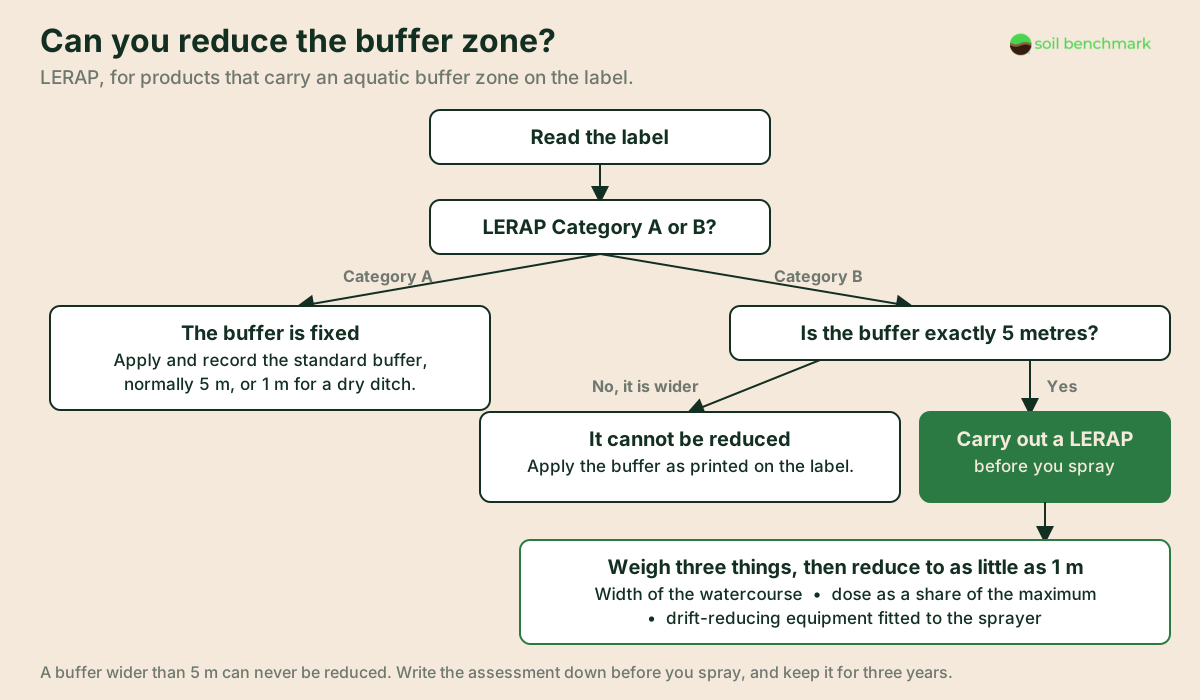
LERAP Category A. The buffer can't be reduced. Apply and record the standard buffer, normally 5 metres, or 1 metre for a dry ditch. These tend to be the organophosphate and synthetic pyrethroid insecticides.
LERAP Category B. The buffer can be reduced, but only after you carry out and record a Local Environmental Risk Assessment for Pesticides.
Two limits on that. Only products with a 5 metre buffer are reducible - anything greater can't be reduced at all. And the floor is 1 metre.
A Category B assessment weighs the width of the watercourse, the dose as a proportion of the maximum, and the equipment, including any drift-reducing technology. It has to be done before the application, written down, and kept for three years. Watercourse width is measured on the day, so a ditch that qualified in July may not in February. In Crop Rex the assessment is captured on the job sheet at the point of application, so it ends up as a dated record rather than a decision somebody remembers making.
Who's allowed to apply
Anyone applying a professional PPP must hold a certificate of competence, or be working under the direct supervision of someone who does while training towards one. The old grandfather rights exemption for operators born before 1965 ended in November 2015.
Certification also has to suit the equipment. A boom sprayer, a knapsack and a granule applicator are separate units.
Who's allowed to recommend
Applying a product and recommending one are two different qualifications, and it's the second that people are vaguer about.
Selling or supplying a professional PPP requires a BASIS Certificate in Crop Protection, or working under the direct supervision of someone who holds one. That's been the position since the Control of Pesticides Regulations 1986.
Advising is policed mainly through assurance. Red Tractor requires that where an adviser advises on PPP use, the recommendation carries the adviser's name and their BASIS Professional Register number. Using an adviser who isn't on the register is treated as a critical failure at audit, not a minor point.
So a written recommendation should name the person who made it and their registration number, and it should sit with the spray record rather than in a separate folder. If a dose or a product choice is ever questioned, the recommendation and the record are read together.
In Soil Benchmark an adviser works in the farm's own account and their name and BASIS number sit on the recommendations they write, so the recommendation, the job sheet and the completed record all carry the same reference without anyone copying it across.
The equipment
Professional application equipment has to be inspected on a set cycle under the National Sprayer Testing Scheme, and kept calibrated between tests. Handheld and knapsack sprayers sit outside the formal testing requirement, but you're still expected to show they apply the intended rate.
Keep calibration records even where nobody demands them. If a dose is ever questioned, a calibration sheet settles it.
The records
Professional users must keep records of every PPP applied for at least three years. As a minimum:
Product name, and ideally the MAPP number
The crop and the field or area treated, with the area in hectares
The date of application
The dose or rate applied.
Aim higher than the legal minimum, because assurance schemes and buyers ask for more: the operator and their certificate, the adviser and their BASIS number, the reason for the application, weather conditions at the time, the LERAP assessment where you made one, and any EAMU you relied on.
Red Tractor expects records completed promptly rather than at the end of the season, and cross-checks a sample against the plan. A record written in November about a May application invites a closer look.
Storage, washings and containers
Products go in a dedicated, secure, bunded store, fire resistant and separate from feed, seed and fertiliser, with an inventory.
Sprayer washings can be applied to a suitable crop or area provided the total dose stays within label limits, or handled through a biobed or biofilter. They must never reach a drain or watercourse.
Empty containers must be triple rinsed or pressure rinsed, with the rinsings going into the tank, before disposal.
Where people get caught out
Total dose, not individual dose. Two passes each legal on their own can breach the seasonal maximum. It's the most common label breach. Crop Rex keeps a running total per crop as you plan, so a second pass that would take you over shows up before you make it rather than at audit.
LERAP assessments nobody wrote down. The decision was made properly in the cab and nothing recorded it, so there's no evidence the reduced buffer was justified.
Recommendations with no name or number on them. The advice was sound and the paperwork can't show who gave it.
EAMU documents nobody can find. The use was legitimate, but the authorisation wasn't held at the time of application.
Expired products still in the store. Revocation dates for sale, storage and use are different, and stock on the shelf isn't permission to apply it.
Last checked 31st August 2026. Approvals and label conditions change constantly - always work from the current label for the product in front of you.
Writing spray recommendations
Plan sprays against the label, and keep the records with them
Crop Rex builds spray plans against the label conditions, so the total dose position for each crop is worked out as you plan rather than discovered afterwards. It produces linked job sheets for whoever's spraying, captures the record at the point of application, and exports the season as a document you can show inspectors or the supply chain.

%20(1).png)